
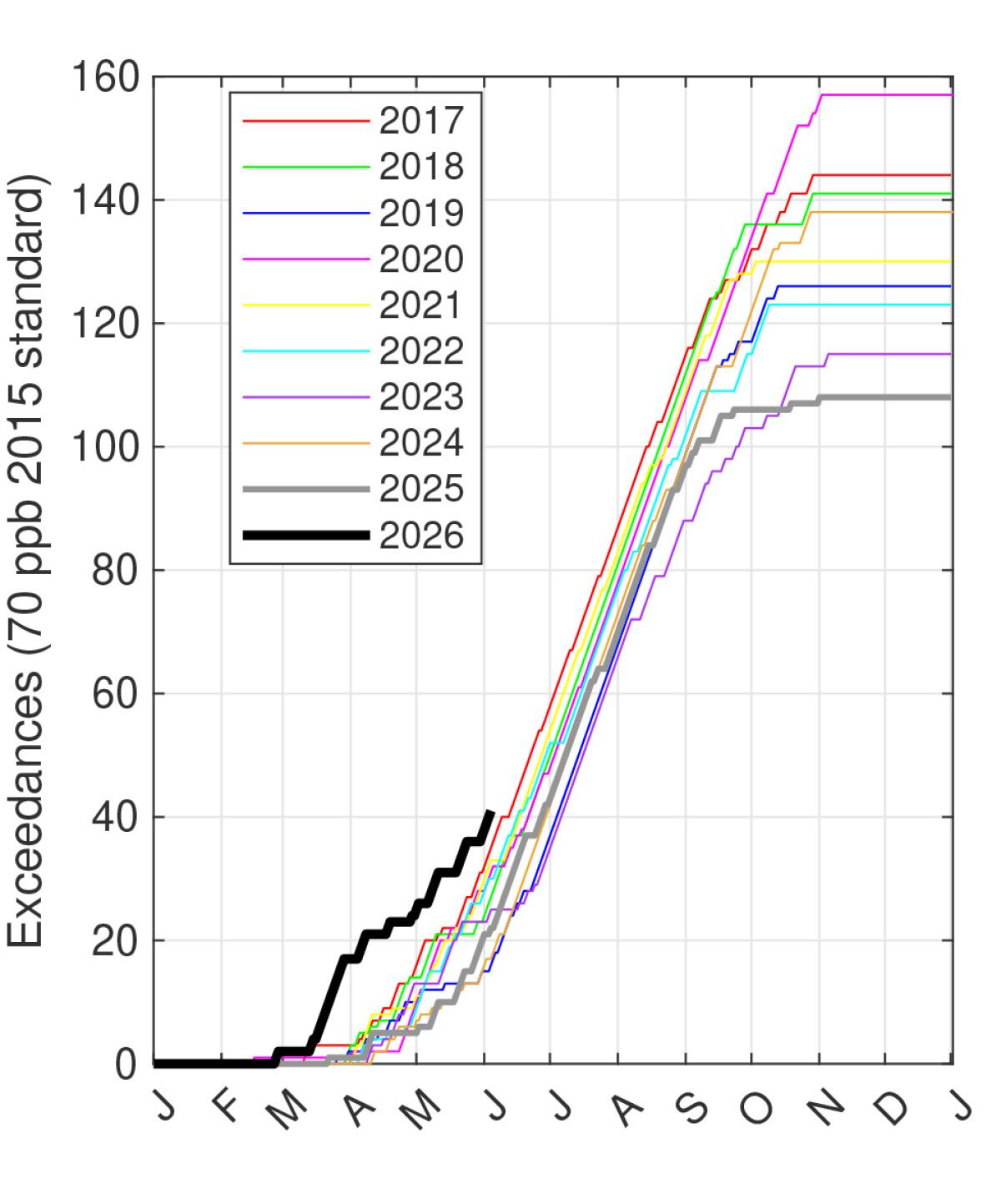
The beginning of 2026 has proven particularly challenging for air quality in Southern California. According to statewide air monitoring, the first five months have seen the highest number of unhealthy air days in over a decade.
The South Coast air basin, which includes counties such as Los Angeles, Orange, Riverside, and San Bernardino, recorded 39 days where ozone levels surpassed federal standards. This surpasses the record from 2017, which experienced 36 such days by early June and totaled 145 for that year.
Approximately 18 million residents of the air basin have faced excessive ozone levels. Ozone, a corrosive gas, can trigger asthma and various respiratory issues. Such high smog levels are surprising for early months, as they typically occur in summer when heat and sunlight amplify pollution.
“If we have this many violations by this time, this could be a really awful year for air quality,” said Adrian Martinez, a director at Earthjustice.
Valley regions have suffered intensely. On April 18, Reseda in the San Fernando Valley noted the second-highest ozone level spike in ten years.
High temperatures, climbing into the 80s and 90s from January to April, have exacerbated the situation. Records show March as the warmest in California’s history, with Riverside experiencing 13 days over 90 degrees.
Sarah Rees of the air district commented on these conditions occurring much earlier than usual, adding to ozone levels.
The South Coast Air Quality Management District directs residents to check pollution via its website and app, advising restricted outdoor activities during high smog levels. Ozone is particularly insidious, as it lacks the visible and olfactory cues of events like wildfires.
The region’s millions of gas cars significantly contribute to emissions. Sunshine acts as a catalyst, while mountain ranges ensnare the pollution.
Efforts to control this pollution date back decades. The state introduced tailpipe emission standards in 1966 and catalytic converters in 1975, achieving substantial reductions over time. However, the area still fails to meet federal ozone standards.
At a recent meeting, officials remembered William Burke, a former air district chair whose leadership contributed to regulations reducing hundreds of tons of smog-forming pollutants daily.
Residents acknowledged environmental improvements yet urged continued progress, recalling past decades when smog obscured mountains for months.
“There’s a lot of invisible stuff that you don’t see, that’s still out there — a lot of particulates in the ozone and chemicals that are causing a lot of problems,” noted Erik Morden, a local resident.
Martinez emphasized the smog’s early arrival as a warning. He advocated for more actions to curb pollution and support zero-emission transitions. The message is clear: while weather is beyond control, pollution is not.