
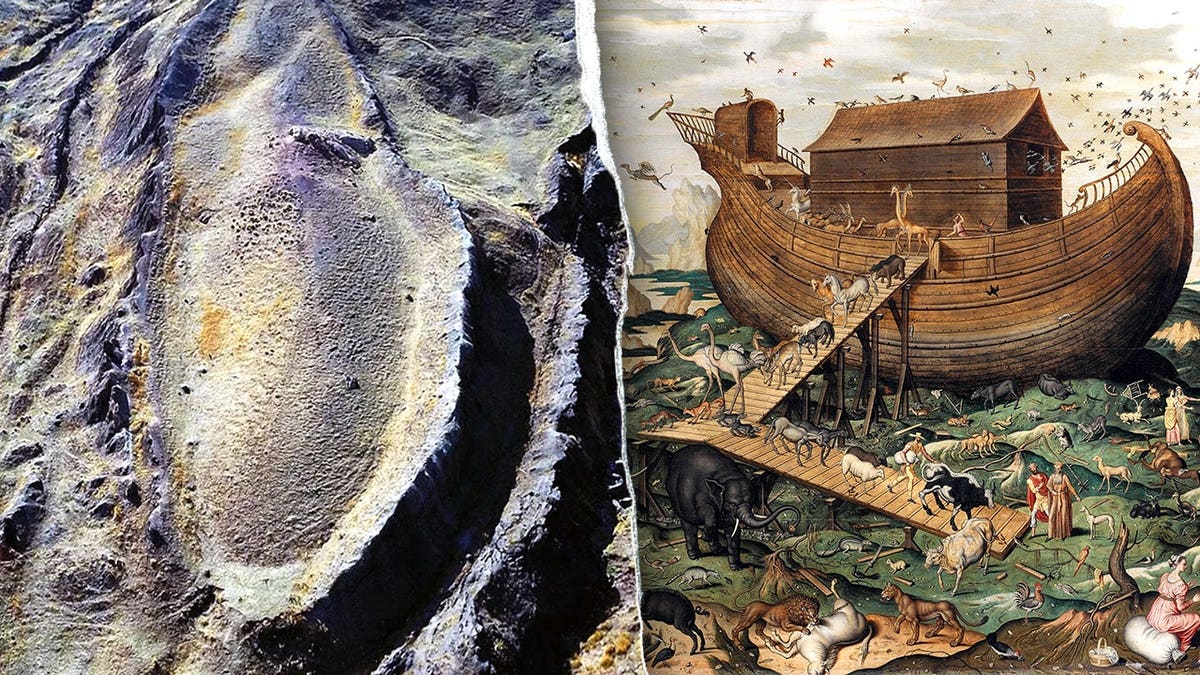
A researcher claims to have found evidence supporting the presence of Noah’s Ark at a site in Turkey. Andrew Jones from Noah’s Ark Scans discussed these findings on “Fox & Friends.” He believes that a site known as Durupinar in eastern Turkey contains the hidden remains of the fabled vessel. The site has been a focal point for researchers and debates since its discovery in the 1950s.
There is ongoing controversy regarding the nature of this formation. While some geologists view it as a natural formation, recent findings present chemical characteristics that support the idea of an ancient ark.
Scientific Analysis and Findings
“The new results are perhaps the most compelling evidence for a man-made origin,” Jones stated.
In 1996, a study published in the Journal of Geoscience Education argued that the site was naturally formed. However, new soil analysis indicates significant chemical differences beneath the surface. This analysis shows variations in soil composition suggestive of decayed organic material, possibly remnants of wood or animal matter.
Jones revealed that samples taken from within the formation showed three times more organic matter than soil just outside it. The findings also highlighted a dramatic shift in both potassium levels and pH inside the formation, which contrasts with the surrounding environment.
Researchers discovered that soil pH inside was eight times different from the external soil. This variation hints at a closed system where biological materials decomposed over time, altering the soil’s chemical profile.
Ongoing Investigations
Jones urged Turkish scientists to conduct further studies, including core drilling and advanced 3-D mapping. His team argues that the current layout resembles a man-made object rather than a natural structure. They argue the length of the formation matches measurements given in the Bible for Noah’s Ark.
The site is in the mountains of Ararat, where evidence of tunnels has been detected four meters below the surface. Some see these findings as further proof of human construction.
Previous analyses have uncovered potential organic material, and anomalies were identified using 3-D ground-penetrating radar scans. These scans highlighted subsurface features that some interpret as supporting the ark hypothesis.