
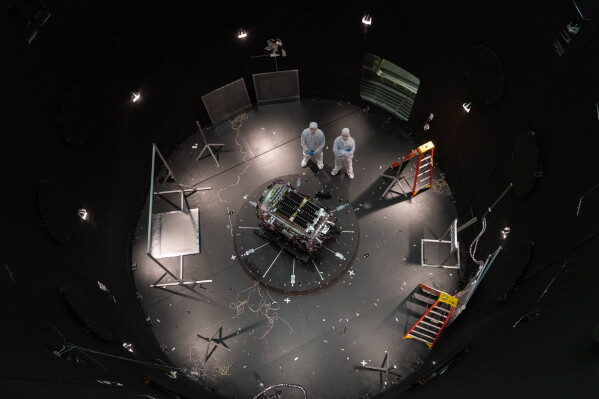
Cape Canaveral, Fla. witnessed the launch of a crucial rescue mission orchestrated by Northrop Grumman and Katalyst Space Technologies. The mission’s objective is to save NASA’s Swift Observatory, which faces the risk of crashing due to its decreasing orbit.
The launch utilized the Pegasus rocket, which was deployed from a modified airplane originating in the Marshall Islands, Pacific Ocean. This setup set the stage for the Link spacecraft to embark on its mission to aid the Swift Observatory in roughly a month.
Swift, originally launched in 2004, faces accelerated descent because of recent solar storms. NASA allocated $30 million for this recovery effort, aiming to restore the telescope’s orbit. Swift is instrumental in monitoring cosmic events such as gamma-ray bursts and exploding stars.
If successful, Swift might resume its operations by September. Current observations are paused to maintain its orbit as long as feasible. There is speculation that a similar rescue might be planned for the Hubble Space Telescope, which is also losing altitude due to atmospheric drag from solar activity.
As of now, Swift orbits Earth at approximately 224 miles (360 kilometers) above the surface. Katalyst intends to elevate its altitude by 150 miles (240 kilometers) to its original launch position. The process involves gradual thrusts from Link’s engines to prevent excessive shaking of the telescope.
The mission’s turnaround was notably swift, taking only nine months. The urgency stemmed from NASA’s warning that recovery would be impossible post-fall. Challenges included weather conditions and technical issues, leading to several launch postponements.
“This is a high-risk, high-reward mission,” noted Ghonhee Lee, CEO of Katalyst Space Technologies. “Avoiding the risk of Swift burning in the atmosphere was our priority, and the team has efficiently circumvented that danger.”
The Associated Press Health and Science Department enjoys support from entities including the Howard Hughes Medical Institute’s Department of Science Education and the Robert Wood Johnson Foundation. Nevertheless, AP remains solely accountable for its content.