
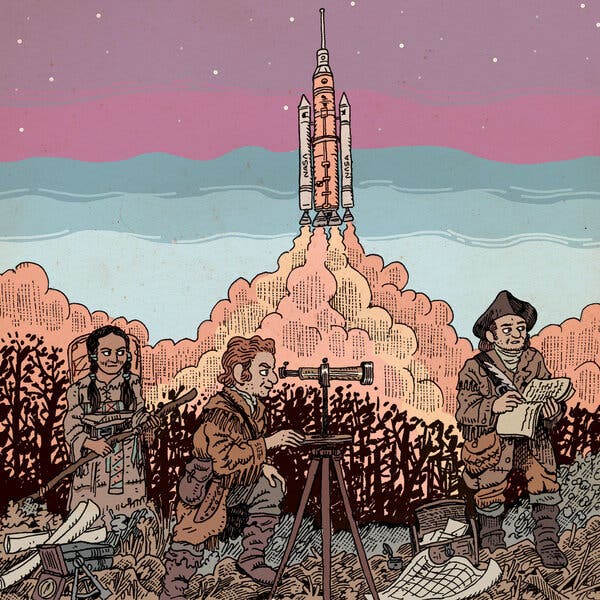
The Trump administration paused or canceled 7,840 research grants last year, as noted by Nature journal. These grants included those funded by the National Science Foundation and the National Institutes of Health. Every week, there seems to be a proposal to cut funds from agencies like the Forest Service or NASA. Such cuts not only jeopardize America’s future but also its historical foundation, as public investments have been pivotal since the nation’s inception. An example of this is the expedition of Meriwether Lewis and William Clark.
In 1804, Lewis and Clark embarked on a mission to discover a trade route via the Missouri River, across the Rocky Mountains, to the Pacific Ocean. However, President Thomas Jefferson had to persuade Congress to fund this endeavor first. From the beginning, American political figures have debated research funding. Jefferson resorted to various tactics to ensure the expedition received financial backing. He requested $2,500 from Congress, although the journey required a larger sum. Upon their return in 1806, the War Department calculated the expedition’s expenses at $38,722.25. Including all related expenditures, the cost likely exceeded $100,000. The federal budget at that time was about $10 million annually, indicating that this expedition took up a similar percentage of annual federal spending as NASA does today.
A significant portion of the funding was allocated to scientific research. Jefferson instructed Lewis to accumulate a vast amount of data while searching for the trade route. The data collection included specimens and descriptions across numerous domains: botany, zoology, geology, climatology, anthropology, economics, and linguistics. Before departing, Lewis consulted with leading scientific minds of the time. Jefferson doubted that these intellectuals could endure the rigorous journey, as he believed it was easier to mold a soldier into a scientist than the reverse.
The entire expedition crew engaged in research. Clark created maps and assisted in recording measurements for latitude and longitude calculations. Sacajawea, a Shoshone woman, collected botanical samples. York, an enslaved Black man serving Clark, gathered invertebrate specimens. Lewis himself was highly involved, owing to his intense and meticulous nature. He observed the visibility of pregnant antelope, described a squirrel’s fur, and even collected minerals, showcasing his dedication to accuracy and detail.
Lewis produced remarkable findings, documenting flowers, rendering bird calls phonetically, and analyzing grizzly bears for scientific data. The mission had imperial goals besides scientific ones. During the Enlightenment, science and statecraft often intersected. Jefferson intended for the expedition’s data to assert America’s future territorial claims. Although Lewis and Clark focused on expansion, they often overlooked the adverse effects on Native populations.
The expedition fostered America’s growth in numerous ways, starting with the fur trade. A trader established a post on the Pacific Coast based on Lewis’s advice. However, the expedition also demonstrated the unpredictability of research outcomes. Clark identified what he thought was a beneficial road. Nonetheless, the more impactful Oregon Trail used a different path. Concurrently, the trader who discovered that vital pass was working at a post founded due to the efforts of the expedition.