
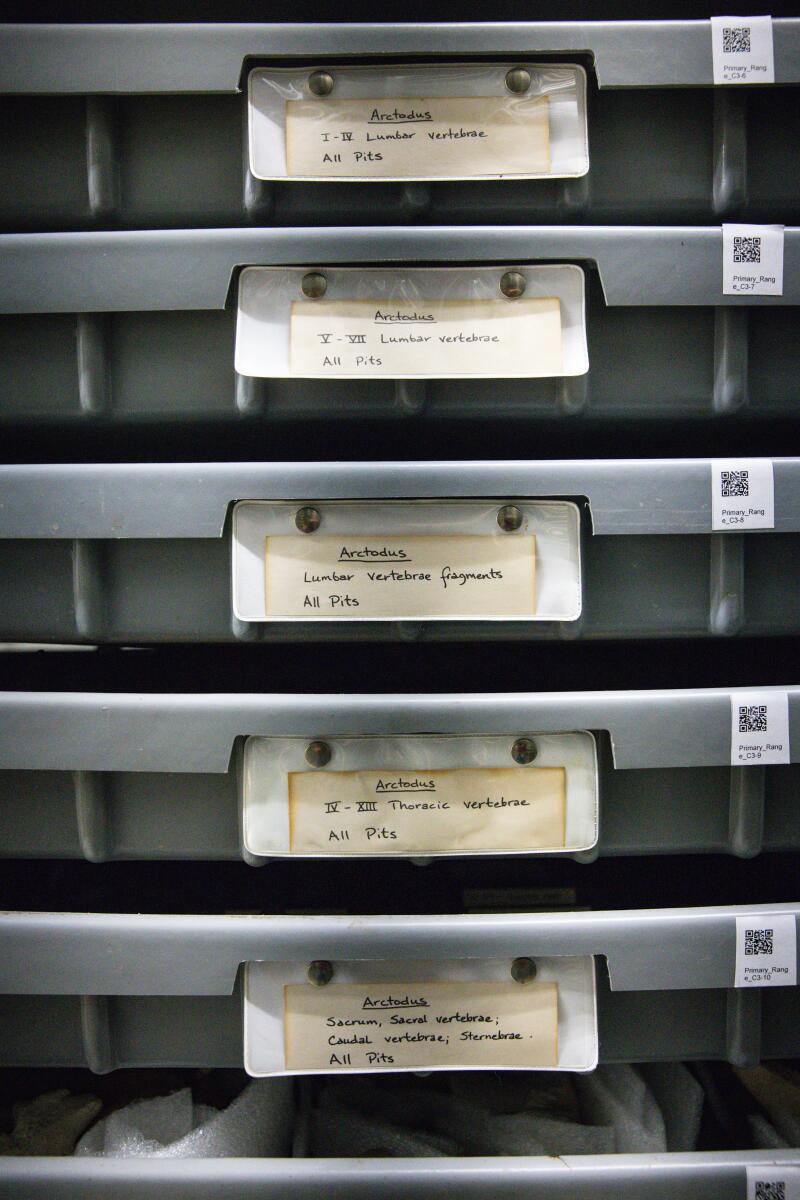
The backstage areas of the La Brea Tar Pits currently resemble a labyrinth. Packing crates lined with handwritten notes such as “bison skulls” and “camel hip” are everywhere. Each bone, even the smallest dire wolf rib, needs careful protection in tailored foam shells. Items like sloth jaws, sabertooth fangs, and an incredible quantity of ancient vertebrae must all be wrapped, cataloged, and packed for a two-year period.
From July 6, the La Brea Tar Pits will close to the public for an extensive renovation. When it opens again in summer 2028, the revitalized Hancock Park museum will serve as the focal point of the Samuel Oschin Global Center for Ice Age Research. This center will focus on a natural history era best defined by the tar pits.
The revamped facility will remain close to the existing building’s layout but will better highlight the museum’s collection. It aims to reveal insights about the preserved ecosystem and its implications for the present world. However, before this can happen, everything must be packed up. About 3.5 million fossils, all delicate and irreplaceable, must be moved, likened to a daunting household move.
The La Brea Tar Pits’ wealth of findings provides unrivaled access to the late Pleistocene epoch. Yet moving the museum away from its historical location is not feasible. Crude petroleum seeping to the surface formed the sticky pits around 60,000 years ago. For the next 49 millennia, these pits trapped almost everything that crossed their path, from pollen grains to unfortunate ancient animals.
This resulted in a comprehensive record of life in what is now Los Angeles during that era. Fossilized dire wolf skulls and other bones need careful packaging during this transition.
According to Regan Dunn, a paleobotanist and curator, no other city has a site like this, which collected a vast representation of Los Angeles life over thousands of years. The era depicted shares striking similarities with today, featuring climate changes and extinction events.
In 2023, Dunn and curator Emily Lindsey utilized this collection to complete a study showing how biodiversity loss in the Ice Age matched human arrival and the inevitable fires they tried to manage.
Lori Bettison-Varga, head of the Natural History Museums of Los Angeles County, emphasized the importance of the Tar Pits’ story in understanding both Los Angeles and the world. The narratives of extinction and resilience facing ecological and climate changes are vitally relevant today.
Currently, the museum’s presentation does not effectively convey this story, according to staff. The George C. Page Museum opened in 1977, but some displays do not reflect modern scientific knowledge. For example, an outdoor mammoth sculpture implies victims were sucked into the tar like quicksand, which is inaccurate. Predators often became trapped after being drawn to struggling prey.
Areas demonstrating the importance of bugs and plants within the ecosystem are limited to outdated exhibits. The saber-toothed cat illusion does not accurately show modern understandings and is unlikely to feature in the redesigned museum.
The museum sought community input on aspects to retain in the new design. The grassy hills ideal for children’s play and the tar pulls exhibit are among those that will stay. The outdoor mammoth sculptures will remain but be altered for scientific accuracy.
Lori Bettison-Varga shared details of the new design. It will optimize space for exhibits and education while the current interior courtyard’s greenery will shift to be more historically accurate.
All current mounted skeletons and several new ones will return. New displays will include a giant ground sloth and Zed, the complete Columbian mammoth under conservation for two decades. Zed will be shown as believed he died, engaging another male in combat.
Volunteers and staff work diligently to relocate collections to other venues during renovation. Recent activity saw volunteers carefully managing fossils by species. Visitors viewed the Fish Bowl, a glass lab where experts clean fossils, while Zed’s remains were on display. Plans for mobile programming aim to substitute for schoolchildren’s educational visits.
Preparation staff find it strange to clean fossils privately, as they enjoy engaging with visiting children. Laura Tewksbury, a senior preparator, noted the joy of interacting with neighborhood kids as they grow.