
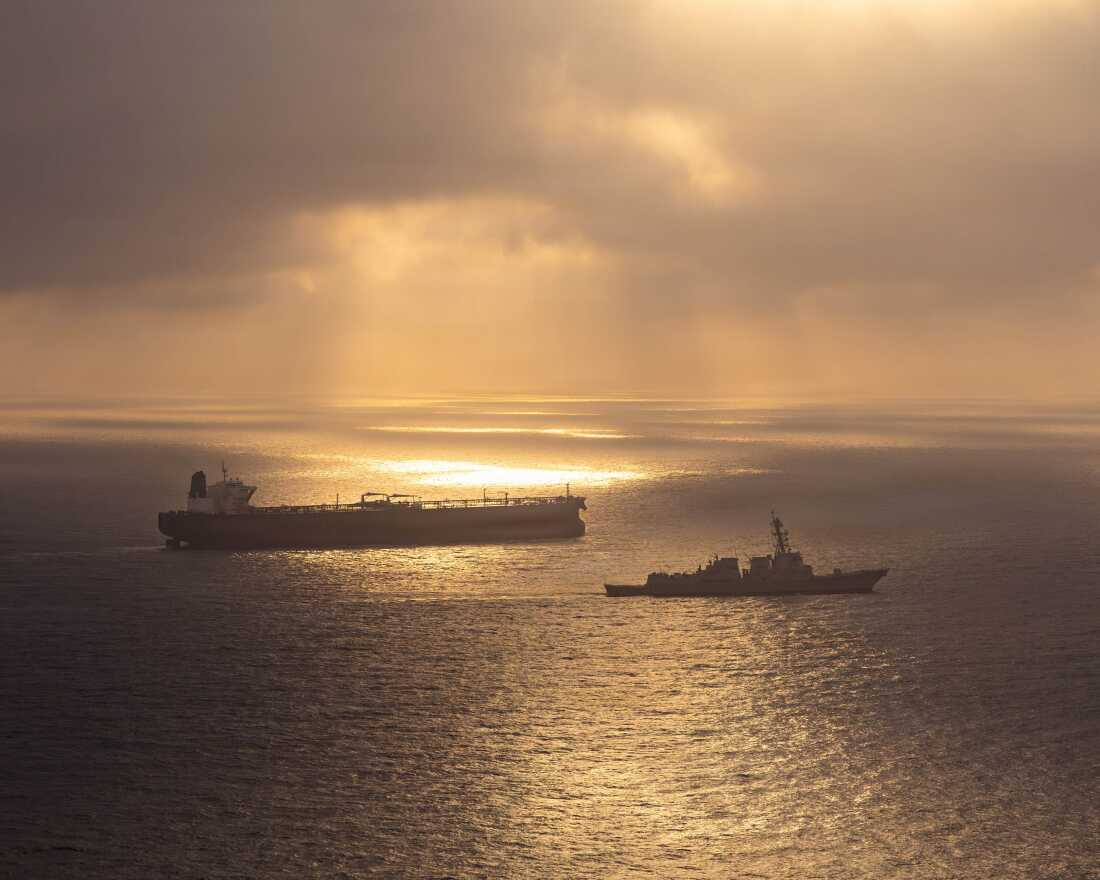
The USS Rafael Peralta, a U.S. Navy ship, participates in a maritime blockade against an Iranian-flagged vessel attempting to reach an Iranian port on April 24. This photo was provided by U.S. Central Command.
At a virtual town hall meeting in Norfolk, Va., Navy families evacuated from Bahrain six months ago raised several concerns. Despite the meeting with officials, answers remain elusive. NPR obtained a recording of the meeting, along with a list of questions posed by families. They left Bahrain unexpectedly, soon after the U.S.-Iran war began, and many still live under temporary circumstances in hotels and short-term rentals, both within the U.S. and elsewhere.
Approximately 580 people joined the call last week, where Navy leaders provided some answers but left much unresolved. Vice Adm. Curt Renshaw, head of the Navy’s Fifth Fleet, acknowledged the difficulties the evacuations caused. He admitted, “We are making it up as we go because nothing is planned for this length of time.” He continued, “These are complex problems and the solutions aren’t obvious.”
When dependents were ordered to evacuate on March 2, Renshaw stated they anticipated only a brief displacement, similar to the 12-day war after U.S.-Israeli attacks on Iran’s nuclear facilities in June 2025. “Unfortunately, this has evolved into a larger and more significant challenge,” Renshaw added. He explained the delay in decision-making was due to hopes of allowing families to return to Bahrain.
U.S. Dependents Left Everything in Bahrain
The conflict left the Navy struggling to support 1,300 dependents who departed Bahrain, the headquarters of the Fifth Fleet, leaving nearly all possessions behind. This number excludes sailors and civilian workers who were also displaced.
One Navy spouse, with two small children, has relocated eight times in six months. Initially moving to Europe, they eventually traveled to various U.S. locations. She prefers to remain unnamed to protect her husband’s career. Her spouse remains stationed in Bahrain. She said, “I need control over my life again, not to be at the administration’s whim. I need to plan and move forward.”
With school approaching for her two children, she anticipates incurring additional costs to maintain a stable location for the school year. “I’m alone in a state with little military presence,” she noted. “No one understands or knows where Bahrain is.” Despite community awareness of higher gas prices, local impact from the war is minimal. “It’s lonely and exhausting,” she added.
Searching for a Permanent Solution
The State Department will soon end the ordered departure policy. Each agency has different rules on how families are compensated under mandatory evacuation orders. “Safety and security of personnel and families remain a top priority,” a State Department spokesperson said. They mentioned the nearing 180-day authorized departure limit for the U.S. Embassy in Bahrain. “We are working to determine the next appropriate steps.”
Families are urged to choose a permanent location while the military decides the fate of those in Bahrain. Qualifying residents would receive housing allowances similar to other military families. Unnamed spouses expressed concern over the prolonged wait, believing the Navy has delayed resolving their situation. They worry about increasing personal expenses.
Few have retrieved belongings from Bahrain. Many purchased additional vehicles and clothing. While Navy tours typically last two to three years, some civilian employees remained in Bahrain over a decade. The Navy couldn’t provide updates on family members lacking U.S. visas.
Vice Adm. Renshaw recognized that some issues stem from outdated policies. Rental car payment caps are unchanged since the 1990s. Naval Support Activity Bahrain serves as a major supply hub but is currently unusable by carriers due to nearby Iranian threats across the Gulf.
Mark Cancian, a retired Marine colonel and former Bahrain resident, described the base as reminiscent of Southern California. Now a military analyst with the Center for Strategic and International Studies, he suggests the war might have transformed U.S. base operations in the Middle East, including in Bahrain. “Families won’t return to Bahrain soon due to safety risks,” Cancian remarked.
The U.S.-Iran war, now six months long, features an extensive U.S. naval blockade and the deployment of two aircraft carriers. With both sides refusing compromise, Cancian predicts the conflict may continue beyond the November midterms.