
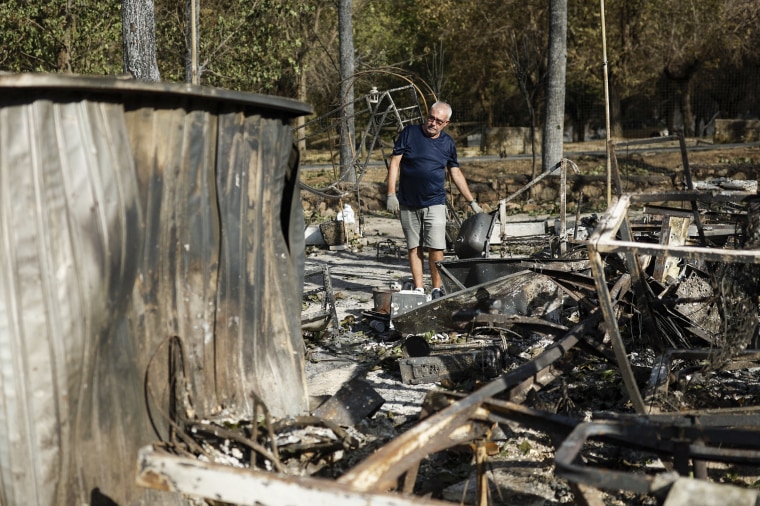
Firefighters in southwestern France managed to control a large wildfire within its boundaries on Saturday. This success enabled approximately 198,000 people to return home following what is possibly the largest peacetime evacuation in the country. Meanwhile, new fires forced the displacement of thousands elsewhere in France and Greece.
In the Mediterranean Var region, a seemingly halted fire unexpectedly spread over four square miles in just six hours on Friday. These opposing developments—mass returns in France’s Gironde region and renewed evacuations in the Var and Greek resort areas—highlighted the unpredictable nature of firefighting conditions.
At their height, wildfires across France and Spain displaced roughly a third of a million people from their homes and vacation spots. This situation strained firefighters, aircraft, and emergency services as they addressed multiple crises simultaneously.
Europe is experiencing the fastest rate of warming globally, heating over twice the global average since the 1980s, based on data from the European Union’s Copernicus climate service. Rising heat and persistent drought dry vegetation, accelerating the spread and intensity of wildfires.
Cap Ferret Remains Evacuated
The Gironde fire engulfed 162 square miles of pine forest west of Bordeaux, an area four times the size of Paris. Firefighters reported that by Saturday, it remained contained within that perimeter, though not yet declared “fixed.” Active areas and underground hot spots continued to challenge efforts.
Communities around the region remained mostly deserted. Authorities kept evacuations in place in much of the affluent and forested Cap Ferret peninsula due to a nearby hot spot that might flare up again, potentially cutting access and trapping residents.
Lt. Col. Eric Pitault stated, “Today, the fire is still not fixed. It is contained,” pointing out that the crews used tactical burns overnight to remove vegetation in risky areas.
The blaze’s impact extended beyond human and material losses. Allain Bougrain-Dubourg, president of France’s League for the Protection of Birds, reported that the fire affected millions of animals.
Fire Roars Back in Southern France
In the Var, containment lines around the Gros Bessillon fire held through the night, preventing further ground loss. However, the fire remained active, with about 2,500 people unable to return home. Over 1,300 firefighters were engaged in the efforts.
Var Prefect Simon Babre expressed incredulity at the blaze’s return, calling it “defies understanding.” On Saturday, twenty French departments faced an orange heat warning, predominantly in the east and southeast, with high temperatures forecast near the Mediterranean.
Gale-Force Winds Batter Greek Resort
In Greece, hundreds of firefighters battled on Saturday to safeguard Porto Germeno, a sought-after resort on the Gulf of Corinth. Gale-force winds spread the flames through the coastal area west of Athens.
The fire ignited on Friday near the neighboring Agios Vasileios village. Approximately 300 individuals were evacuated by sea, and authorities issued further evacuation instructions on Saturday.
“A pristine forest, a paradise, was surrendered to the hands of the fire,” commented Minas Tzortzanis, a local resident, expressing the devastation in the area.
Theodore Giannaros, a wildfire meteorologist at Athens’ National Observatory, estimated that 15 to 19 square miles were affected, although authorities had not confirmed the burned area.
Nearly 500 firefighters, including French and Romanian crews, were supported by 19 water-dropping airplanes and 11 helicopters to tackle the flames. Local assessments indicated home destruction, though a complete count was pending.
New fires emerged elsewhere in Greece on Saturday, prompting evacuation alerts for at least four villages near Nafpaktos.
Climate Crisis and Civil Protection Minister Evangelos Tournas highlighted the challenging conditions created by strong winds, which obstructed aircraft from collecting and deploying water effectively.