
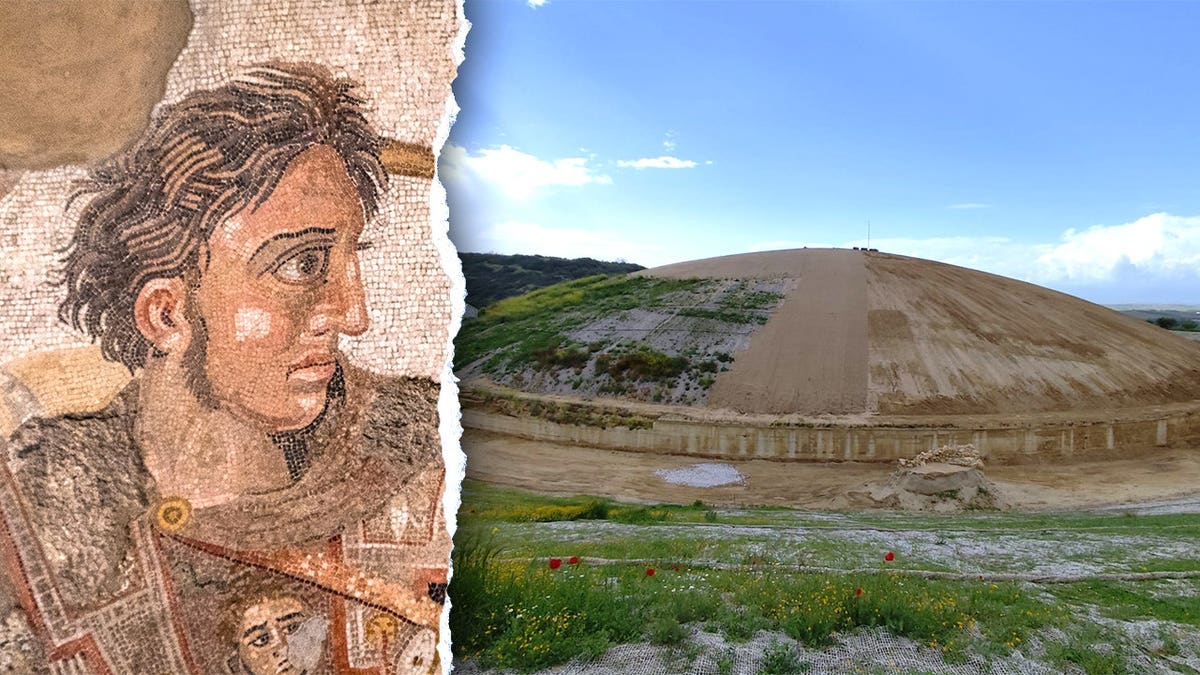
Greek officials have revealed the interior of the massive Kasta Tomb, a site potentially linked to Alexander the Great. This announcement comes as archaeologists further their excavation and restoration efforts at the site. The tomb is located in Amphipolis, an ancient Macedonian city in northern Greece, approximately 60 miles from Thessaloniki.
Restoration Uncovers Historical Significance
Greece’s Ministry of Culture reported that restoration work has exposed the full enclosure of the Kasta Tomb for the first time. The fourth-century B.C. structure measures around 1,630 feet in circumference and encompasses a burial mound over 20 acres. Images from the site highlight marble-lined corridors, intricate architecture, and detailed sculptures, hinting at a connection to the Macedonian elite.
Old metal supports were removed to showcase the tomb’s interior. Future restoration plans involve installing a monumental double-leaf Macedonian marble door and fixing parts of the sphinx sculptures that once stood guard at the entrance.
The Kasta Tomb’s Historical Role
“The Kasta Tomb is a unique and magnificent Macedonian monument, which, through the completion of the work of restoring its geometry, but also revealing the entire enclosure, now clearly highlights its historical importance and its value,” said Lina Mendoni, Greek minister of culture.
Amphipolis is historically significant, linked to key figures from the Kingdom of Macedon including Alexander the Great’s generals Nearchus, Hephaestion, and Laomedon, as noted by the Ministry of Culture. After Alexander’s death, his mother Olympias’ loyalty was secured, but the city only surrendered to Cassander, a successor of Alexander, upon her directive. Tragically, Cassander later imprisoned and murdered Alexander’s wife, Roxana, and his son.
Legacy of Alexander the Great
The ongoing excavation suggests that the tomb may have been built for someone close to Alexander the Great, such as his mother, a spouse, or a close friend, as speculated by researchers and reported by National Geographic in 2014. These discoveries are part of a broader interest in projects related to Alexander, including locating his long-forgotten cities.
Earlier this year, archaeologists identified a city established by Alexander, known as Alexandria on the Tigris, near Iraq’s Persian Gulf. This site offers further insights into the expansive Macedonian Empire, which Alexander founded in his short yet impactful life, ending with his mysterious death at 32.