
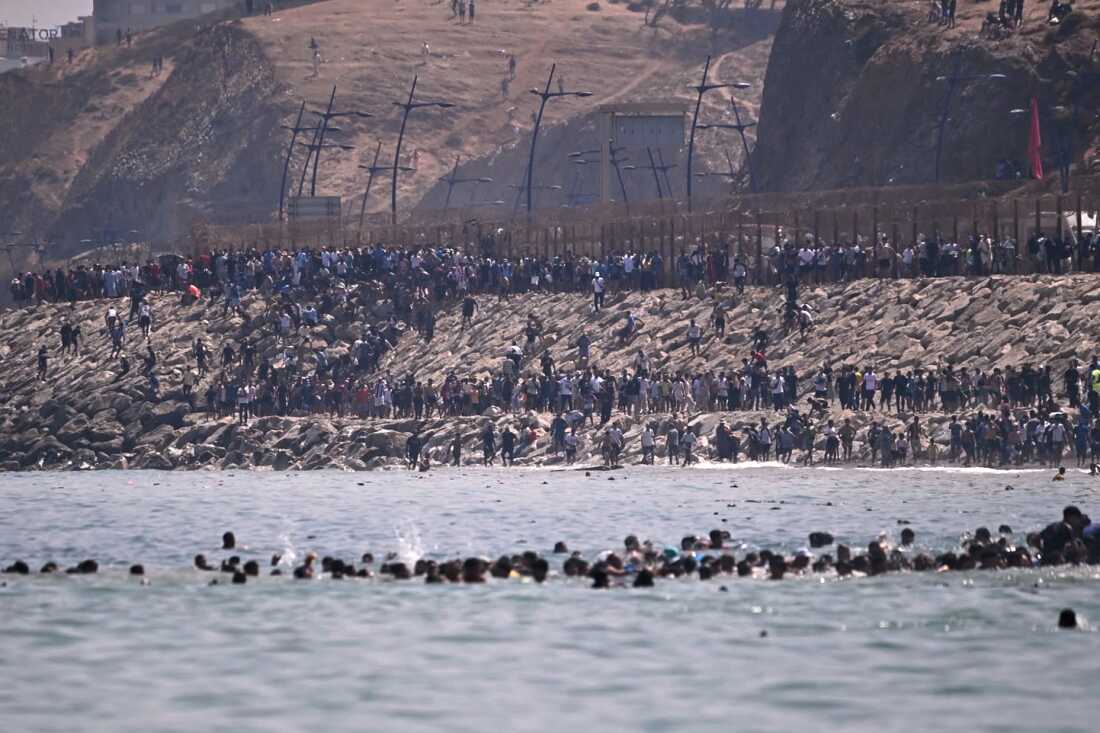
On Thursday, July 30, 2026, thousands of migrants entered the Spanish enclave of Ceuta from Morocco. The influx led Spain to deploy military forces to restore order, following requests from local authorities for additional help.
Antonio Sempere/AP hide caption toggle caption Antonio Sempere/AP
This decision by Spain’s government came after local officials in Ceuta highlighted a significant breach of the border fence, leading to chaos. The Spanish government planned to send the Armed Forces to support the Civil Guard in re-establishing security in Ceuta. Additionally, Prime Minister Pedro Sánchez and Interior Minister Fernando Grande-Marlaska planned to visit Ceuta to address the crisis.
According to Rachid Sbihi, who heads an association representing Spain’s Civil Guard in Ceuta, the situation was chaotic, with thousands crossing the border. Sbihi described the border as having ‘totally collapsed’. Achraf Maimouni from the Moroccan Association for Human Rights characterized the scenario as unprecedented.
Many of the migrants, including young men, women, and children, arrived at Ceuta’s Tarajal beach and continued onto local roads. Chanting ‘Viva España,’ they were caught on camera crossing into Spanish territory. Tragically, at least nine migrants died during these chaotic events, with bodies observed in the water.
Arrivals have been increasing, but the cause of the surge remains uncertain. The Spanish Interior Ministry noted Morocco’s cooperation in managing the situation, with Moroccan police actively preventing attempts to cross into Ceuta illegally. Both nations agreed to expedite the return of migrants who entered unlawfully.
Despite requests from Ceuta’s local authorities, the Spanish government decided against declaring a national emergency over the migrant situation. Italy, another key destination for migrants, reacted to this crisis with concern, as its Premier Giorgia Meloni warned she might suspend the Schengen agreement with Spain in response. Although this may seem reactive, it highlighted broader European concerns over migration.
The recent incidents in Ceuta trace back to a Spanish Supreme Court ruling. This decision prevents immediate returns of sea-arriving migrants, though it does not apply to those entering overland. However, activists in Morocco doubt this legal ruling was widely known among migrants, questioning its impact.
Ceuta is a major entry point for migrants seeking better opportunities or fleeing violence. Located on Africa’s northern coast, it draws migrants willing to swim from Fnideq or Belyounech in Morocco to reach European soil. Recent scenes are reminiscent of May 2021’s border crisis when thousands also entered Ceuta amid tensions between Spain and Morocco linked to the treatment of Polisario Front leader Brahim Ghali in a Spanish hospital.
Ceuta’s head, Juan Jesús Vivas, emphasized the strain on local infrastructure. He called for the army’s presence, due to national security concerns, to protect the border and ensure citizens’ safety. Belongings left behind by crossing migrants floated in the sea, illustrating the challenges faced by the enclave.
The Spanish Interior Ministry reported nearly 3,000 migrants have entered Ceuta by mid-July 2026. However, the ministry declined to confirm recent numbers pending its next migration report release.
Ceuta, historically under Spanish control since 1580, is known for its mixed population of Christians, Muslims, Spaniards, and Moroccans. The community generally coexists peacefully, despite the challenges posed by continuous migrant ventures over the fence seeking a better life in Europe.