
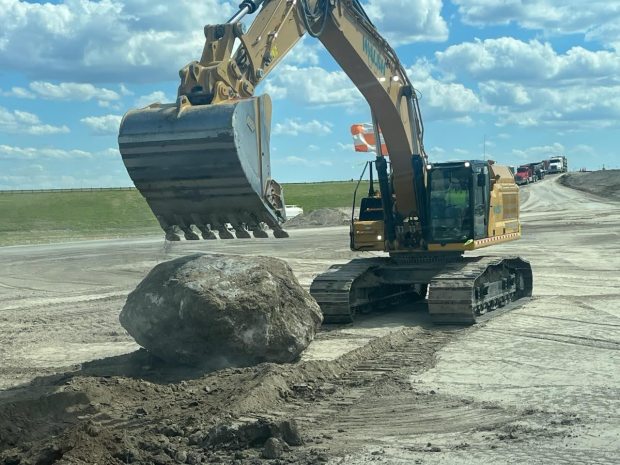
Ron Pitelka began his rock collection at age 23. Working on a construction site in Chicago’s southwest suburbs, he found an egg-shaped limestone boulder about 5 feet wide. Armed with his first dump truck, he transported the 10,000-pound stone home.
Over the next twenty years, Pitelka amassed several hundred rocks. His mother’s place in New Lenox houses some of them, while about a hundred are at his home in Homer Glen, southwest of downtown Chicago. Despite the collection lining his driveway and house, Pitelka suspects his neighbors are not thrilled.
This summer, Pitelka unearthed his largest boulder yet at O’Hare International Airport. Working for Walsh Construction on the terminal modernization project, he and bulldozer operator Matt Tracy uncovered a 50-ton boulder from 30 feet underground. The project is part of an $8.8 billion renovation effort.
The Chicago Department of Aviation identified the stone as dolostone, a sedimentary carbonate rock. Dolostone holds historical significance in Illinois and was declared the state’s official rock following a campaign by elementary school children.
“Naming contests for the rock received over 2,300 submissions, with suggestions like Da Layover and The BaRock Obama Boulder among them,” stated CDA spokesperson Kevin Bargnes.
Contractors often prefer to break boulders, but Pitelka says it’s wasteful. He recalls burying vibrant blue granite boulders in Plainfield, lamenting their loss.
According to Pat McLaughlin, a scientist with the Illinois State Geological Survey, Illinois dolostone dates back over 400 million years, originating in a tropical sea. Glacial movements later shaped the rock into the boulder discovered at O’Hare.
The O’Hare boulder, estimated to have formed between 12,000 and 15,000 years ago, now resides outside the airport’s Multi-Modal Facility, open to public viewing.
Pitelka’s enthusiasm for excavating rocks began early, rooted in both his father’s profession and childhood play. Despite the stress involved in excavation work, he finds joy in the unpredictability.
Public submissions for the boulder’s name close soon. Pitelka prefers a simple name like “Geo”, appreciating its geological significance and timeless nature.