
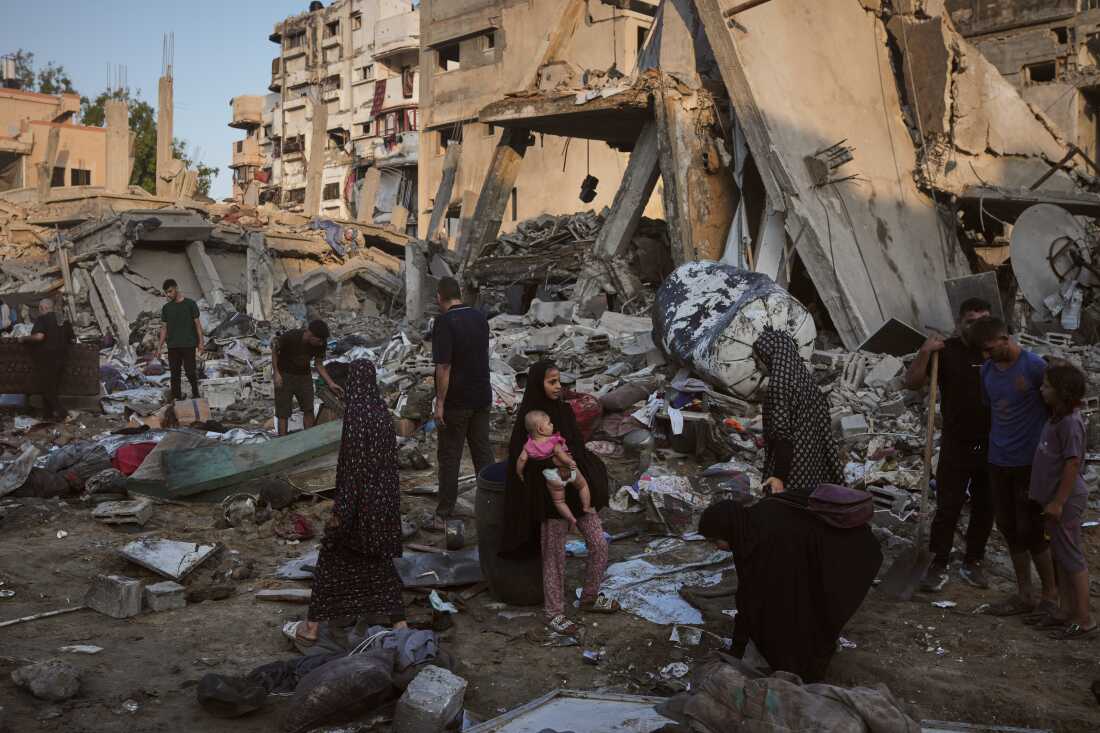
Palestinians are seen gathering their belongings from the remnants of their homes after an Israeli airstrike in Gaza City on July 30, 2026. The airstrike demolished buildings and tents in the area.

In Washington, President Donald Trump announced an agreement for Hamas to disarm and for Israel to withdraw its forces from Gaza. However, significant challenges remain in resolving the conflict in the region. Neither Hamas nor Israel has yet confirmed their acceptance of the agreement.
This announcement comes nine months after a U.S.-brokered ceasefire. Talks between Israel and Hamas have stalled over the second phase of the ceasefire, which includes Hamas’s disarmament and Gaza’s reconstruction.
The agreement will be carried out in carefully structured phases. As disarmament is completed, Israeli forces will withdraw, and the International Stabilization Force will work with a new Palestinian police force to ensure Gaza’s safety for its residents and neighbors,Trump stated on social media.
The plan outlines a 20-point proposal focusing on Hamas surrendering its weapons and dismantling its tunnels. Israel is to withdraw as a new Palestinian government forms, supported by international security forces to rebuild Gaza.
Despite the announcement of an agreement to implement the complex Gaza ceasefire, negotiations have remained stagnant, and military actions increased during a U.S. and Israeli conflict with Iran, a key Hamas ally.
White House officials gave an optimistic view of the deal, mirroring Trump’s earlier promises when the international Board of Peace was established to supervise the Gaza ceasefire. Although disarmament timelines for groups in Gaza, like the Palestinian Islamic Jihad, remain vague, officials suggest that weapon handovers could start in two weeks. Yet, many Hamas militants and heavy weaponry are not part of this initial agreement phase.
A process lasting between 200 and 350 days is proposed for the complete disarmament and dismantling of infrastructure, according to a Board of Peace representative.
The U.S. acknowledged Israel’s skepticism of Hamas’s willingness to disarm. A U.S. official confirmed Israel was engaged in each negotiation step. However, Israel’s role focuses on previous commitments, including withdrawing forces and halting airstrikes.
Israel’s U.N. Mission and officials issued no immediate remarks, while Trump indicated disappointment would follow if Israel deviated from the agreement.
President Trump and Prime Minister Benjamin Netanyahu had met earlier in the week without revealing details of their discussions. Meanwhile, Iran remains a critical but unpredictable factor, counseling Hamas against the agreement while facing its conflicts with the U.S.
Despite traditionally refusing disarmament, Hamas dissolved its government in Gaza, agreeing to U.N.-backed power transfer steps.
The Gaza conflict began after a 2023 Hamas attack in southern Israel, leading to substantial casualties and hostages. Israel’s counter-offensive has led to over 73,000 Palestinian deaths, with Gaza’s military control and destructed areas causing dire conditions for its population.