
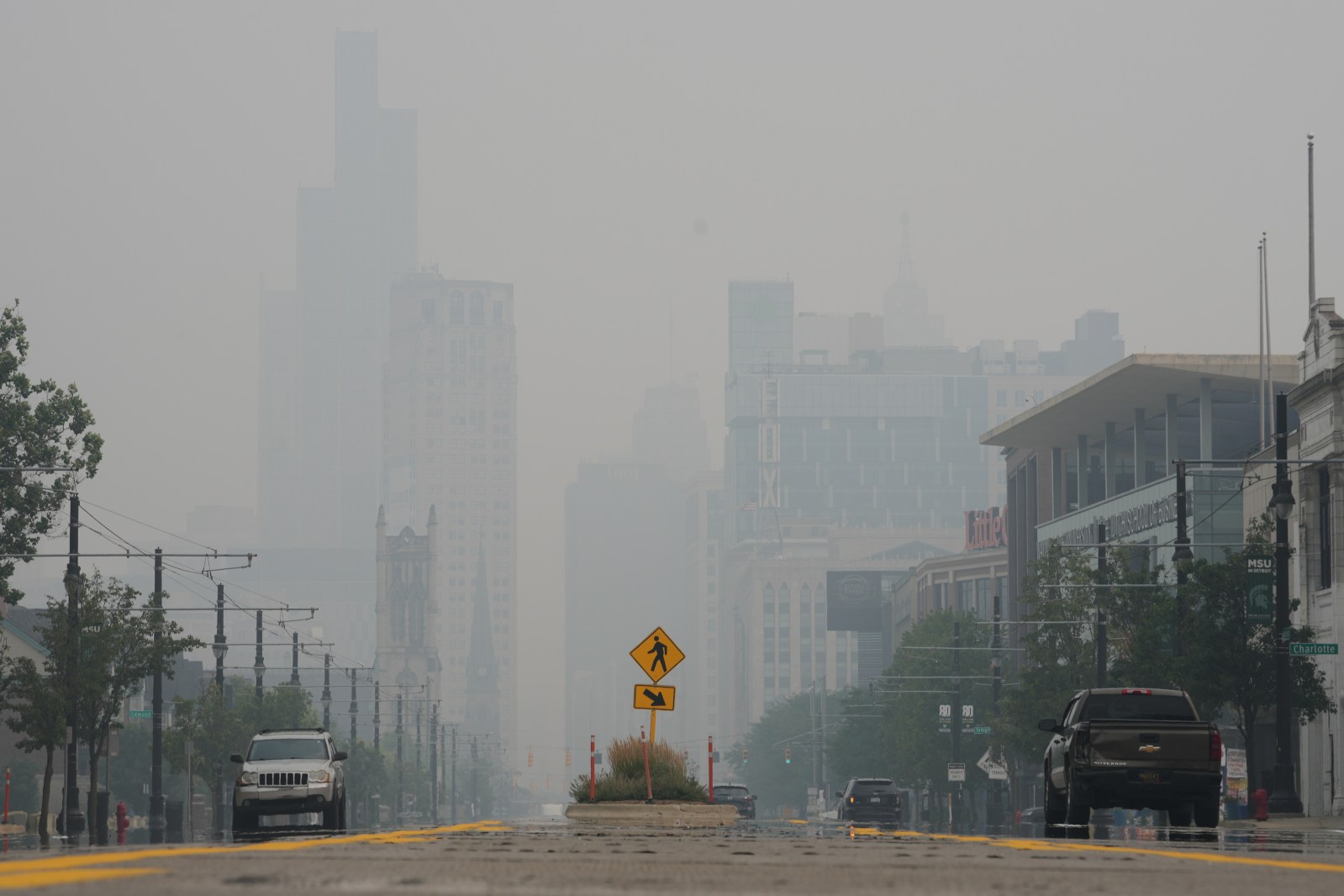
U.S. Cities Battle Worst Air Quality Due to Canadian Wildfire Smoke
In recent days, several U.S. cities have experienced notably poor air quality due to smoke from Canadian wildfires impacting the Midwest and Northeast. On Friday, three U.S. cities topped a global ranking for worst air quality. Detroit registered a ‘very unhealthy’ U.S. Air Quality Index (AQI) reading of 240 during the early afternoon, earning the top spot among major cities tracked by Swiss air-quality firm IQAir. Following closely, Chicago reported an ‘unhealthy’ AQI at 199, and Washington, D.C., recorded a level of 172. Meanwhile, New York City was eighth with a reading of 131.
Outside the U.S., Kinshasa in the Democratic Republic of the Congo reported an AQI of 186. New Delhi, recognized as the world’s most polluted city in 2025, had an AQI of 163, while Jakarta showed a reading of 144. Residents in New Delhi are frequently exposed to pollution, evidenced by an average annual PM2.5 concentration of 99.6 µg/m3.
Understanding PM2.5 Pollutants
The term µg/m3 is widely used to measure airborne pollutants, representing micrograms per cubic meter—essentially the mass of pollutants within a specified volume of air, according to the U.S. Environmental Protection Agency.
PM2.5 particles are small, persistent, and found in various pollution sources, including vehicle emissions, wildfires, and industrial activities. Due to their microscopic size, PM2.5 can penetrate buildings and human respiratory systems, posing immediate and long-term health risks. Consequently, PM2.5 is often cited in AQI reports for its probability to exceed safety thresholds.
Wildfire Impact on Air Quality
The ranking offers a snapshot of air quality in over 100 cities, influenced by transient pollution and weather. The U.S. cities’ high ranking reflects smoke’s immediate impact, not their usual air quality.
The National Weather Service noted hazardous air quality in Detroit from wildfire smoke, with alerts in effect. An expected change in wind direction offers hope for improvement.
Spread of Canadian Wildfire Smoke
Smoke from fires in northern Ontario traveled south, affecting the Great Lakes region, Midwest, and Northeast. This caused alerts in several states and resulted in decreased visibility, particularly in New York City, where the skyline was masked by haze.
Officials advised residents in affected areas to remain indoors or use high-quality masks while outside. In New York City, several outdoor activities were canceled, cooling centers opened, and masks distributed amid elevated temperatures and smoke-caused hazards.
Detroit experienced severe conditions with AQI readings from 300 to 500 overnight, signifying hazardous air quality as weak surface winds allowed smoke retention. Dense-smoke advisories affected Lake Huron, Lake St. Clair, and Michigan waters of Lake Erie.
Forecasts suggested improvement with shifting winds, although ongoing fires in Canada mean potential for further smoke dissemination.
Protection Against Wildfire Smoke
Health experts recommend N95 or KN95 respirators when avoiding wildfire smoke is impossible. These masks can filter fine airborne particles effectively when properly worn, which is crucial to prevent microscopic particulate matter inhalation.
Dr. Tyler Evans from Wellness Equity Alliance emphasized that N95 and KN95 masks are essential for filtering out tiny particles. They must fit well, as air leakage compromises efficiency. Minimizing outdoor exposure and maintaining clean indoor air are the first defenses.
The Public Health Agency of Canada agrees, advising the use of snug-fitting respirators and cautioning against their use while sleeping. Notably, specific individuals, including young children and those requiring assistance, are advised against respirator use.
Newsweek offers further analysis on this topic.