
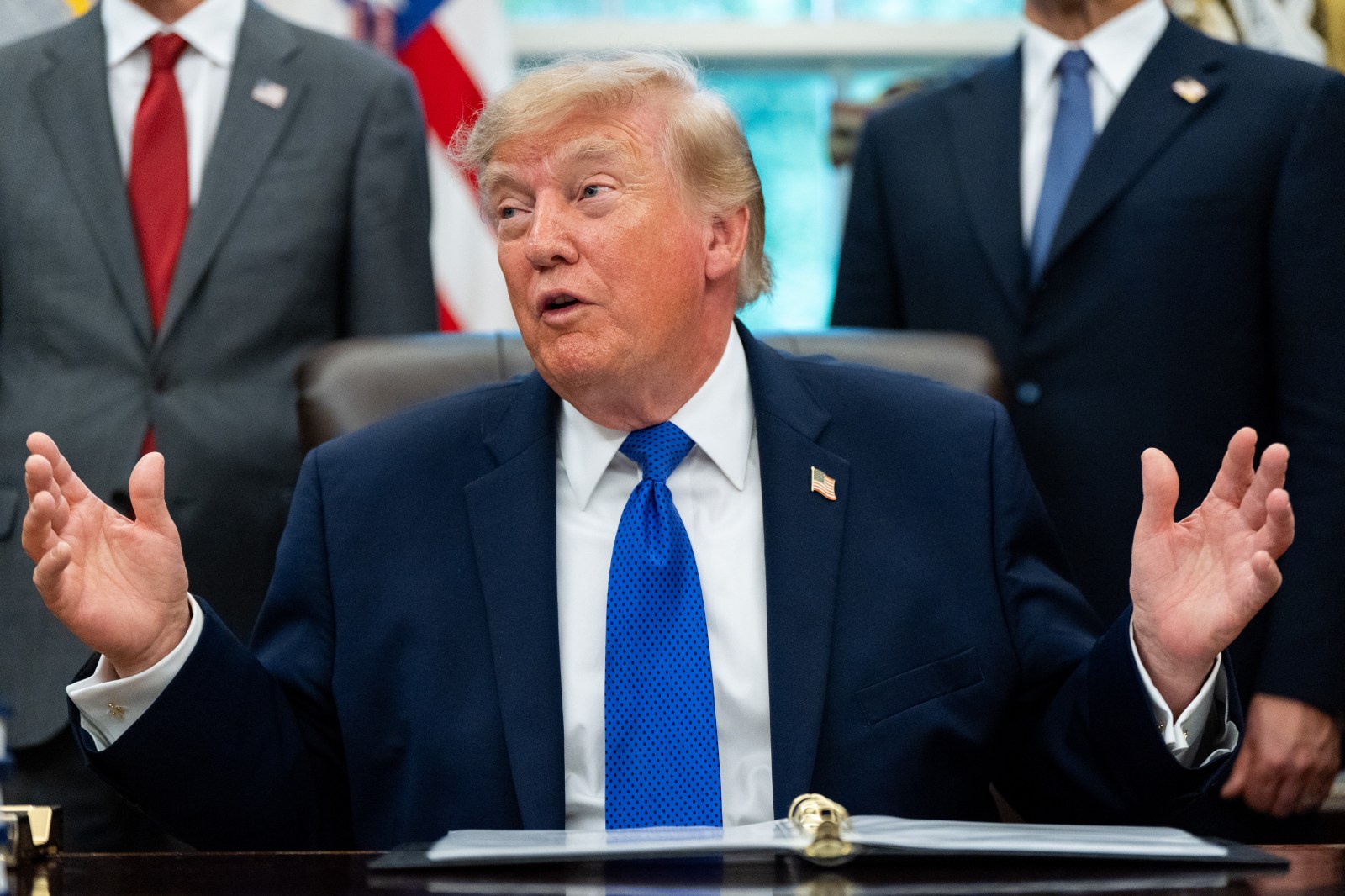
President Donald Trump escalated his criticisms of Canada on Monday, labeling it a “one of the worst countries in the entire world” as trade tensions between the United States and Canada heightened. Following the imposition of 50 percent tariffs on approximately $28 billion worth of Canadian goods last month, Prime Minister Mark Carney retaliated with his own tariffs, equal in measure.
During an Oval Office press event, Trump accused Canada of unfair treatment toward the United States, specifically pointing out what he termed excessive tariffs on American agricultural exports and claiming Canadian leaders possess undue entitlement. He remarked, “They want to have a deal with us,” concerning Canada’s repeated communication with the U.S. “The issue is, they have treated the United States very unfairly. They have been one of the worst countries in the entire world. We have good relations with many countries like China; we make profitable deals, but Canada has posed considerable challenges. Their tariffs on our farmers exceed 400%, and they exploit us. They feel entitled.”
Trump also contended that Canada extensively depends on the U.S. economy, offering minimal contribution in exchange. He highlighted American support that ranges from military cooperation to icebreaker services, suggesting Canada’s excessive reliance on its southern neighbor and emphasized that “there’s nothing they have that we need.” Despite this assertion, Canada remains the United States’ second-largest trading partner, trailing only Mexico in trade volume.
Trump’s remarks coincided with Carney’s endorsement of the idea for Canada to become the European Union’s first associate member, which he argued would deepen economic connections with Europe and safeguard Canada’s markets from dominance by any single nation.
As relations with Washington fray, Carney is focusing efforts on reinforcing diplomatic engagements elsewhere. He is pursuing a trade agreement with India and has mended relations with China through steps like reducing tariffs on Canadian canola and facilitating the entry of a limited number of Chinese electric vehicles into Canada’s market.
Todd Belt, a political management professor at George Washington University, expressed to Newsweek that the Trump administration likely did not foresee the current developments. He commented, “Donald Trump underestimated Carney’s determination.” Belt believes Trump presumed he could easily influence Carney due to his recent political ascent, which proved incorrect.
Belt elaborated that Trump’s administration failed to anticipate Canada’s retaliatory tactics. “The Canadians would respond in kind, strategically aiming at Senate toss-up seats,” he noted, referencing states such as Michigan, Ohio, and Alaska.
This is a breaking news article. Updates to follow.