
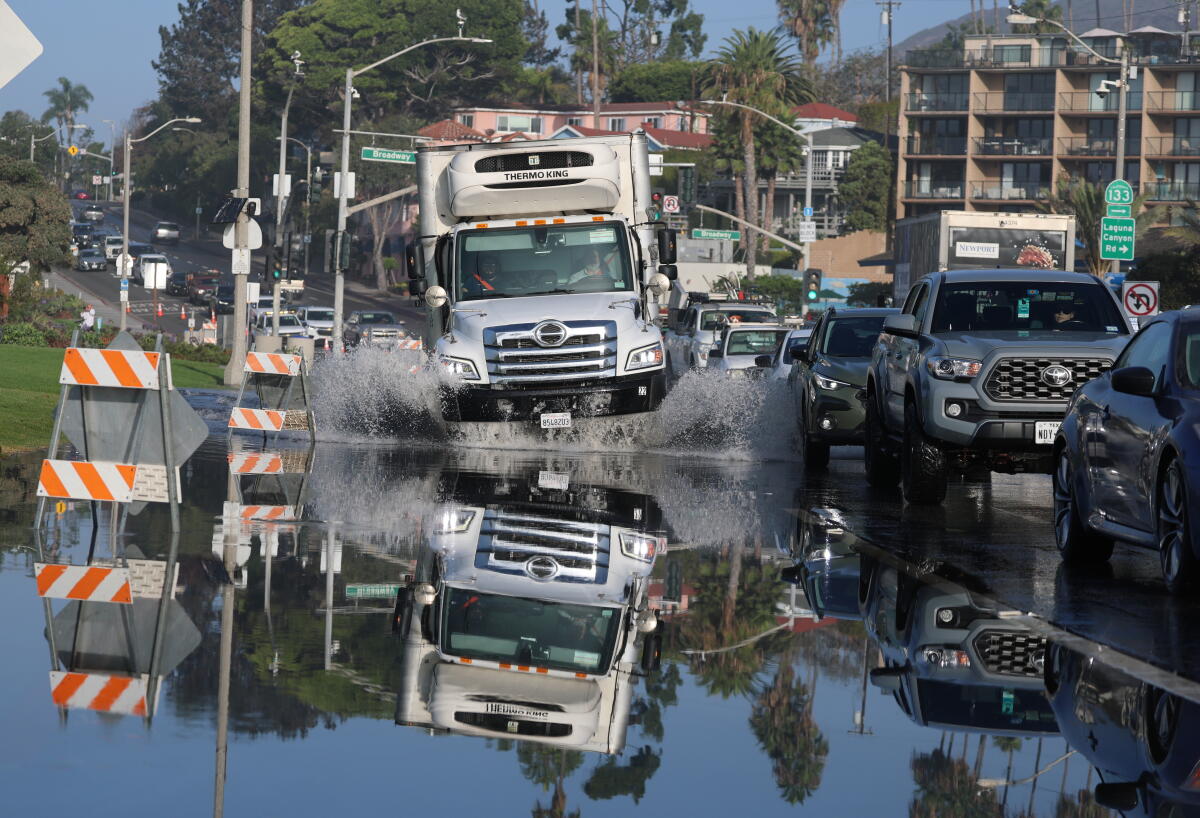
Approaching Storm Threatens California Coast
Tropical Storm Rachel is expected to reach northern Baja California or San Diego County by Saturday night. The storm poses significant threats, including coastal flooding. The National Hurricane Center indicates Rachel could strengthen before hitting the coast, an atypical scenario for storms in the tropical eastern Pacific. Such storms usually lose intensity in cooler waters. However, El Niño conditions and a present marine heat wave have increased ocean temperatures by 10 to 13 degrees above normal, making the environment more favorable for Rachel’s intensification.
“It’s notable that this is an unusual event that’s being made possible by both coincidence of this early arriving low-pressure trough off the coast of California and the record warm ocean temperatures off the coast of California right now,” stated Daniel Swain, a climate scientist with UC Agriculture and Natural Resources.
Expected Flooding and Warnings
The National Weather Service in San Diego announced a rare tropical storm watch for major parts of San Diego County, including cities like Chula Vista, Carlsbad, and Oceanside. Coastal flooding remains the primary concern, especially for south-facing shores given higher tides and the approaching storm. Water intrusion and hazardous surf, with waves between 3 to 6 feet, are expected. On Friday, residents in Laguna Beach observed streets and sidewalks flooded due to high tides.
Experts predicted tides in Southern California to elevate by 1 to 1.5 feet more than the norm because of warmer ocean temperatures due to El Niño. On Friday morning, high tide was 17 inches above predictions in San Diego and La Jolla, while Santa Monica and San Francisco saw elevations of 16 and 14 inches, respectively.
Miguel Miller, a meteorologist, remarked, “We’ve got water that’s already high and then we’re going to have periods of high tides each morning and evening and then on top of that we have high surf.”
Until Tuesday afternoon, Ventura, Los Angeles, Orange, and San Diego counties remain under coastal flood advisory. Flooding is possible in areas like beach parking lots, roads, and boardwalks, with minor coastal erosion anticipated.
Rainfall Predictions
Though Rachel’s remnants could bring only light rain to Southern California, areas like the Mojave Desert, Inland Empire, and San Diego County may experience heavier precipitation. The weather service projects a moderate 40% chance of excessive rainfall instigating flash floods in cities such as El Cajon, Palm Springs, and Chula Vista.
For regions like Oceanside, Laguna Niguel, Riverside, San Bernardino, rain potential stands at 15%, and a lower 5% chance for areas like Huntington Beach, Santa Ana, and Anaheim. Los Angeles County anticipates light to moderate rain, possibly accumulating between a quarter inch and an inch. In the San Gabriel Mountains, slightly more rainfall is expected, while Orange County might see half an inch to an inch.
Historical Perspective on Tropical Storms
Historically, only two tropical storms at full strength have passed through California. El Cordonazo in 1939 impacted Long Beach and San Pedro, depositing 5.62 inches of rain and causing 45 deaths due to flooding. Another storm, Nora in 1997, sustained tropical storm strength along the California-Arizona border with resulting street flooding in Southern California.
Such events are commonly associated with El Niño seasons, linked to greater hurricane activity in the eastern Pacific and increased rainfall in Southern California. The present El Niño, categorized as “very strong” by NOAA’s Climate Prediction Center, is deemed potentially the strongest since records began in 1950.
In past “very strong” El Niños, regions like downtown Los Angeles experienced an overabundance of rain, over doubling average annual amounts. Conversely, the 2015-16 season resulted in diminished rainfall but corresponded with severe coastal erosion.