
Media Restrictions at APEC Summit
Throughout the day at the APEC summit, journalists faced significant media restrictions. On Thursday, these included limitations on video recordings during certain key moments. During a meeting between President Putin and President Trump, Russian authorities barred two journalists from entry. Meanwhile, in a meeting with President Xi, President Trump lamented the media’s limited access, stating, “Too bad the media couldn’t see some of it, because every move was perfectly executed.”
After the meeting between Trump and Xi, Chinese officials denied a Bloomberg reporter access to a trilateral meeting because she had shouted a question about Jensen Huang. Chinese officials informed pool reporters that yelling questions was deemed extremely impolite and that reporters doing so would be removed. This reporting practice is common in the U.S. Despite attempts by the White House to allow the journalist entry, Chinese officials maintained their stance.
Putin’s Views on Ukraine’s Security
After the trilateral talks at the APEC summit, President Putin discussed Ukraine’s right to security. He emphasized that Ukraine’s security should not come at Russia’s expense. Putin noted President Trump’s discussion about global interest in resolving the conflict in Ukraine. He stated the conflict requires a compromise on the Ukrainian side to reach a resolution.
European Security Concerns
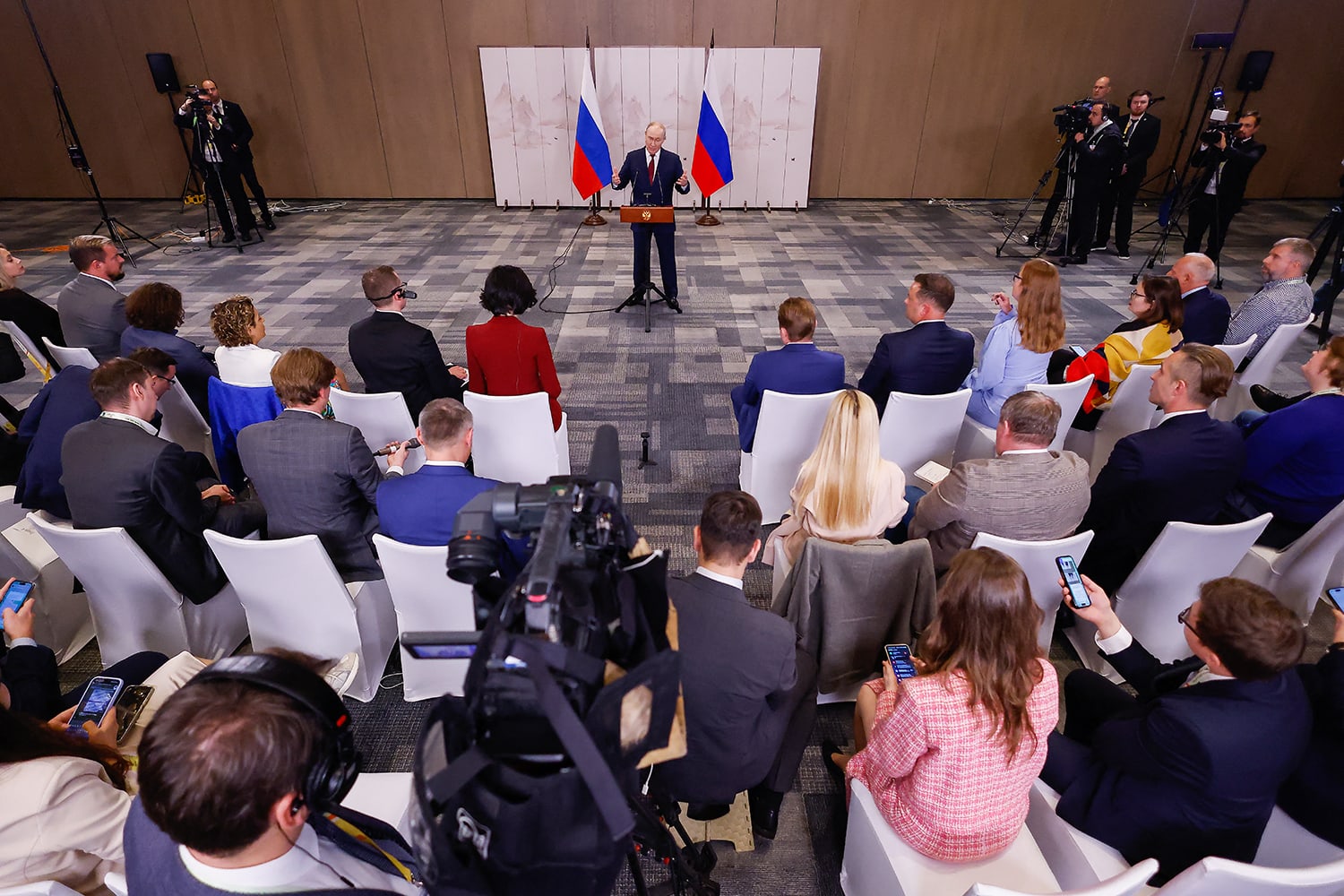
At a news conference following the APEC summit talks, Putin expressed a need for Russia to better understand European security concerns. He acknowledged the futility of discussing these issues without European representatives. As of now, no dates have been established to continue this dialogue.
Putin’s Position After the Summit
Following the summit, Putin appeared to emerge as an early winner. His 2022 invasion of Ukraine had led to global isolation, but at this summit, he engaged with leaders of the world’s two largest economies. China and Russia, but not yet the U.S., released statements supporting increased energy production to support Russia’s economy.
Joint Statements on Global Issues
China and Russia released identical statements emphasizing four key points: reforming the United Nations, increasing petroleum production, warning the International Criminal Court against power abuse, and reducing nuclear war risks. A U.S. version of the statement was not immediately available. The statement, titled “China-Russia-U.S. Declaration on Peace,” underscored a commitment to strategic stability and international security.
Denuclearization Discussions
During the summit in Shenzhen, Xi Jinping, with Trump and Putin, described nuclear weapons as a “sword of Damocles” over humanity, highlighting the responsibility of the three biggest nuclear powers for global peace. Xi called for a world free of nuclear weapons in the long term. He urged the powers to prevent nuclear conflict, uphold the NPT, and maintain global security. Putin echoed this view, emphasizing shared responsibility as reported by Kremlin sources. Trump prioritized nuclear arms reduction in these discussions.
Focus on Ukraine in Trump-Putin Meeting
Russian aide Yuri Ushakov, present at the Trump-Putin meeting, noted Ukraine was a central topic. He reported a positive atmosphere and that discussions also covered summit preparations and bilateral relations.
Nuclear Agreement Challenges
President Trump advocated for a new nuclear arms control agreement involving the U.S., Russia, and China. However, Russia and China expressed little interest in committing to new limits. Russia had previously suspended its participation in the New START treaty following its 2022 invasion of Ukraine. Despite its expiration approaching, Russia claimed adherence to the treaty’s arsenal limitations for another year. Trump insisted any future agreement must encompass China and potentially other nuclear powers as well.
China asserted that an arms control agreement should remain between the U.S. and Russia, which hold the majority of the world’s nuclear arsenal. According to the Pentagon, China has around 600 nuclear warheads, which could increase to 1,000 by 2030 if current growth rates continue.