
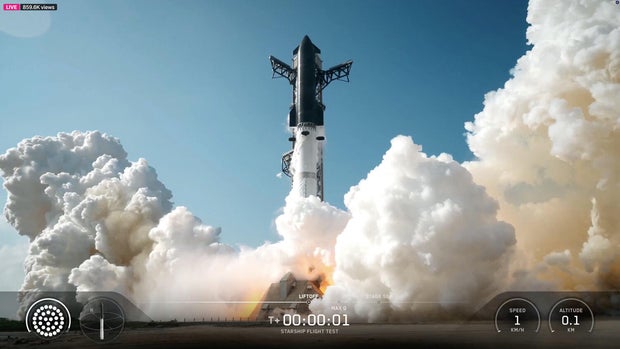
SpaceX launched an enhanced Super Heavy-Starship rocket on Friday to test upgraded engines and control systems needed to improve operation safety and reliability.
During the launch from SpaceX’s Starbase facility in Texas, one of the Super Heavy’s 33 methane-fueled Raptor 3 engines shut down early. Additional engines failed during an attempt to return the stage to its planned splashdown near the Texas Gulf Coast.
The Starship upper stage, equipped with six Raptor engines, saw one optimized for vacuum shut down early. Flight computers kept the other engines running longer to compensate, achieving a sub-orbital trajectory. In space, the Starship deployed 22 Starlink satellite simulators, two with cameras sending images from space.
SpaceX considers the Super Heavy-Starship rocket crucial for launching large batches of satellites and missions to the moon and Mars. Engineers will conduct multiple test flights to resolve any issues.
When the Super Heavy booster separated from the Starship upper stage, several engines did not fire correctly, preventing it from reaching its splashdown point, dropping into the Gulf short of its target.
The Starship upper stage, despite the engine failure, reached a satisfactory trajectory. It completed a successful re-entry and splashdown in the Indian Ocean. The rocket broke apart and exploded on impact, but survived the heat of re-entry in good condition.
Version 3 test flights are crucial milestones on the journey to becoming the first fully reusable rocket for launching government, commercial satellites, and future Mars piloted missions.
NASA is working with SpaceX to develop the Starship upper stage as a lunar lander for the Artemis program, aiming to land astronauts on the moon by 2028. Test flights are crucial, and both SpaceX and Blue Origin must successfully launch an unpiloted moon mission before Artemis III.
With its upgraded rocket, SpaceX plans to transition from sub-orbital test flights to orbital missions, focusing on systems needed for moon missions. One significant challenge is refueling a Starship lander in orbit before heading to deep space. SpaceX plans the first orbital refueling tests later this year.