
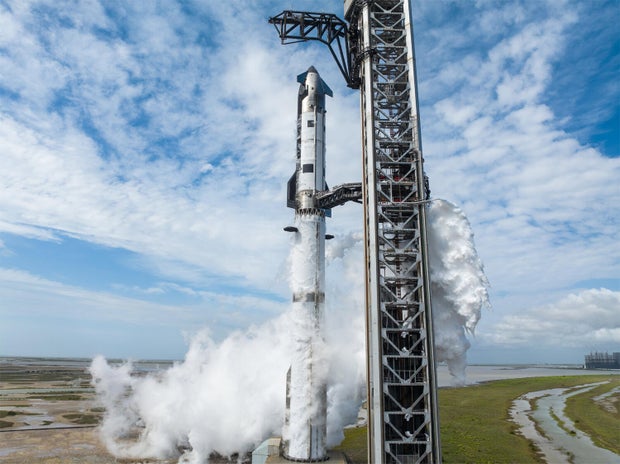
A new version of SpaceX’s Starship rocket, featuring enhanced engines and significant safety improvements, is set for launch this Thursday. This event represents a crucial milestone for Elon Musk’s rocket company and for NASA’s Artemis program. NASA relies on SpaceX to deliver a human-rated Starship upper stage to transport astronauts from lunar orbit to the moon by the end of 2028.
SpaceX has prepared its Super Heavy-Starship rocket for its 12th sub-orbital test flight with supercold liquid methane and oxygen propellants. NASA remains cautious, working with Blue Origin as a backup plan for lunar lander development. Artemis III will focus on rendezvous and docking procedures in low-Earth orbit, using either or both landers based on readiness.
SpaceX aims to perfect the launch system with this test flight after previous successes and failures. The debut of the version 3 Starship marks a new chapter, utilizing a reinforced pad at SpaceX’s Starbase launch site on the Texas Gulf Coast. Weather permitting, the launch is scheduled for 6:30 p.m. ET Thursday.
Upon launch, the version 3 Super Heavy-Starship will benefit from reduced refurbishment needs between flights, enabling more frequent launches. The 33 methane-fueled Raptor engines will power the upper stage past Earth’s lower atmosphere. Following separation, the first stage will attempt a splashdown off the Texas coast rather than a catch.
SpaceX stated that the test’s primary goal involves a successful launch, ascent, stage separation, and landing burn at an offshore Gulf of America landing point, avoiding a return to the launch site. Meanwhile, the Starship upper stage will reach a sub-orbital trajectory before descending into the Indian Ocean about one hour and five minutes after liftoff.
Starship’s upper stage carries Starlink satellite simulators, testing the heat shield’s readiness for future missions. The first stage utilizes 36 Raptor engines burning methane and oxygen to propel the rocket out of the atmosphere.
The planned re-entry trajectory stresses the spacecraft’s rear flight control flaps, mimicking future return missions. Around 50 onboard cameras will document the flight, transmitting imagery through the Starlink system.
SpaceX learns from previous flights to improve subsequent launches. Version 3 of Starship aims to demonstrate redesigned features for rapid reuse. This model carries up to 18 million pounds of liftoff thrust, surpassing NASA’s moon rocket capability.
Beyond launching satellites, Starship aims to serve as a NASA moon lander, posing complex technical challenges. Doubts persist about its readiness for 2028, yet SpaceX’s reusable Falcon 9 boosters have set a precedent. A Starship moon lander necessitates refueling post-Earth orbit, requiring several tanker flights.
Russia’s Progress cargo ships routinely fuel the ISS; however, transferring large cryogenic propellants autonomously in space presents new challenges. SpaceX is still developing methods to minimize propellant boil-off.
For the lunar landing, Artemis astronauts will dock the Starship, descend to the moon’s south pole, and maneuver the 170-foot rocket amid challenging terrain. Safe touchdown involves an external elevator for surface access.
The contract with NASA stipulates an unpiloted lunar mission before considering astronaut use, marking a major step in space exploration and the broader goal of reaching Mars.