
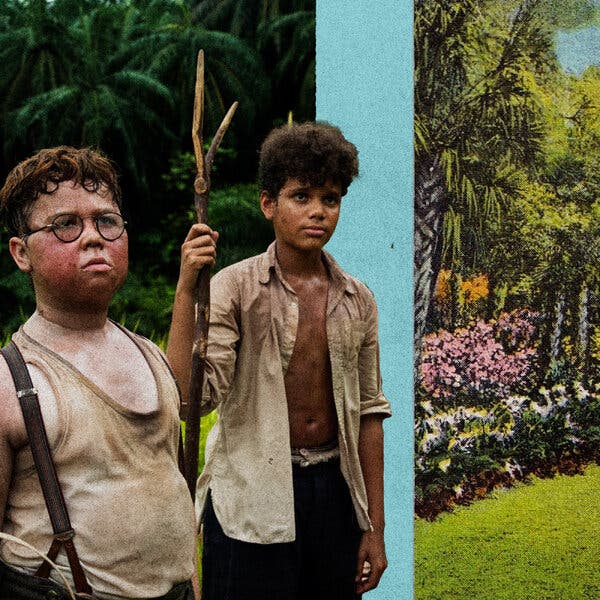
In my school days, William Golding’s “Lord of the Flies” was an ever-present part of education. The novel, with its Nobel laureate author’s prestige, persists on bookshelves, though its presence is not as strong as it was. Despite its renowned status, the novel is from the 1950s, a time when few works have stood the test of time in today’s fast-paced, non-reading culture.
The book’s portrayal of human savagery was provocative in 1954. However, amid modern-day challenges like school shootings and increasing teen suicide rates, the struggles portrayed in the novel now seem antiquated to many. The themes of violence and chaos appear outdated, especially when one considers other stark narratives like “The Chocolate War”, “The Hunger Games”, or Japanese stories such as “Battle Royale” and “The Drifting Classroom”
In this contemporary setting, a new, supposedly faithful adaptation of “Lord of the Flies” has been made available on Netflix by Jack Thorne, the writer behind “Adolescence”. This release prompts the question: Does the original imagery of a pig’s head on a stick still carry a message for today’s audience?
The novel’s influence is enduring, but it has been overshadowed by numerous works it inspired over the past seven decades. Author Drew Basile compared “Robinson Crusoe” to a progenitor of countless islands; in a similar sense, Golding’s novel has spawned a vast array of stories situated on dark, fantastical islands. The influence is pervasive, leading to challenges in keeping readers engaged who are already familiar with its central themes.
While not everyone has read “Lord of the Flies”, its themes and mythologies are widely known due to its many adaptations and references across various media. This cultural saturation is evident in graphic novels, video games like “DayZ” and “Rule of Rose”, and television series such as “The 100”, “From”, and “Yellowjackets”. In literature, similar narratives appear in works like Sarah Goodwin’s “Stranded” and Pierce Brown’s “Red Rising”.
Stephen King’s writing also heavily draws from “Lord of the Flies”, with clear tributes like “The Long Walk” and his fictional town, Castle Rock, named after a significant location in Golding’s novel. Similar elements can be identified in King’s works “The Stand”, “Under the Dome”, “The Mist”, and “The Shining”.