
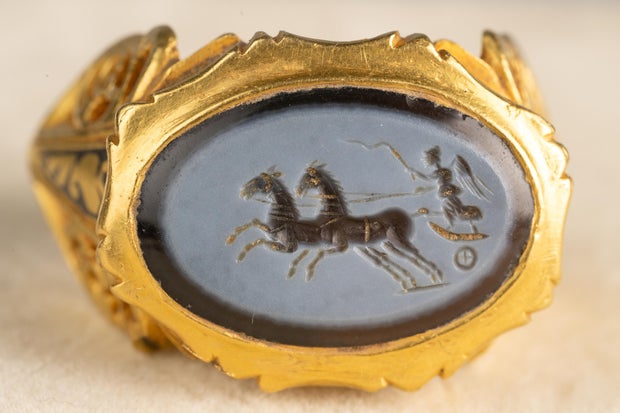
An amateur metal detectorist in England recently struck gold by uncovering a rare Roman ring over 1,700 years old. The ring, depicting Victoria, the goddess of victory, was discovered by Kevin Minto in a field in Ilminster, England, and has been named the Ilminster Ring. The South West Heritage Trust confirmed its purchase of the ring for over $105,000.
According to Amal Khreisheh, a senior curator at the South West Heritage Trust, the Ilminster Ring is noted for its significant size and weight, with intricate goldwork and a finely detailed intaglio. This makes it a breathtaking piece comparable to continental counterparts. This ring dates back to Roman-occupied Britain in 279 AD and has been considered a remarkable archaeological find since its discovery by Minto in 2018.
Weighing 48 grams, the Ilminster Ring is much larger than typical rings, featuring an engraved gemstone, or intaglio, of the goddess Victoria — known in Greek mythology as Nike — depicted riding a chariot drawn by two horses. Khreisheh noted that its discovery provides insights into the challenges faced by Roman inhabitants in South Somerset during a period of turmoil from 286 to 296 AD. It is believed the ring was buried with other items like coins and pottery shortly after 297 AD.
Ilminster, where the ring was found, is a location in Somerset, known for its Roman artifacts. In addition to the ring, Minto found a hoard of coins as part of his search. Historical discoveries in the area include the Frome Hoard, a collection of over 52,000 Roman coins found by another detectorist in 2010, and valued at significant historical interest.
Both the Ilminster Ring and the famous Frome Hoard are housed at the Museum of Somerset. The museum also displays the Chew Valley Hoard, a notable collection of more than 2,500 silver coins from the Norman Conquest era, valued at over $5 million, further emphasizing Somerset’s significance in uncovering England’s historical treasures.