
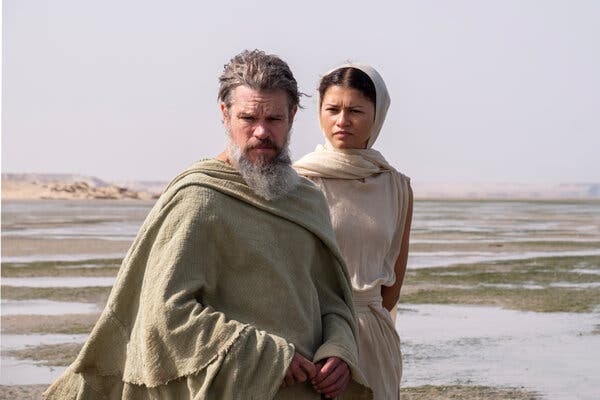
Christopher Nolan stands out as a director who brilliantly bridges the gap between art films and blockbusters. His latest work, an adaptation of ‘The Odyssey,’ exemplifies this skill.
Throughout his career, Nolan has tackled significant stories, often centered around men, their conflicts, and their wars. He bends these narratives to his distinct style. His characters repeatedly test the limits of human capability, mirroring Nolan’s exploration of cinematic possibilities.
Nolan’s passion for cinema is evident in each frame of ‘The Odyssey.’ This adaptation is a signature Nolan production. It combines thematic depth, formal creativity, and thrilling visuals with unmistakable showmanship.
It’s fitting that Nolan would eventually adapt ‘The Odyssey,’ one of Western literature’s foundational works. The story’s complexity and layered narrative align well with Nolan’s methodical style. Penned by Homer, the epic poem comprises over 12,000 lines of intense, nonlinear storytelling. It involves gods, mortals, and supernatural events, culminating in a tale ingrained in cultural memory. Even those unfamiliar with the original work recognize parts of it, mirrored in countless modern narratives.
Nolan’s version of ‘The Odyssey’ stands out for being the first film shot entirely in IMAX. It’s an impressive studio production featuring stars like Matt Damon as Odysseus and Zendaya as Athena. Nolan transforms this ancient poem into a thoughtful film with the glamour of old Hollywood.
The story follows Odysseus, who has been absent for two decades following the Trojan War. Played by Matt Damon, Odysseus emerges as a nuanced character, more understandable to today’s audiences. His absence has left a void for his wife, Penelope (Anne Hathaway), and son, Telemachus (Tom Holland). Nolan emphasizes Odysseus’s magical journeys but also focuses on the family turmoil caused by his absence, highlighting the often-overlooked domestic struggles in male-centric adventures.
‘The Odyssey’ by Christopher Nolan is not just a cinematic achievement but a reflection on war and its consequences, enhanced by Nolan’s unique filmmaking capabilities.