
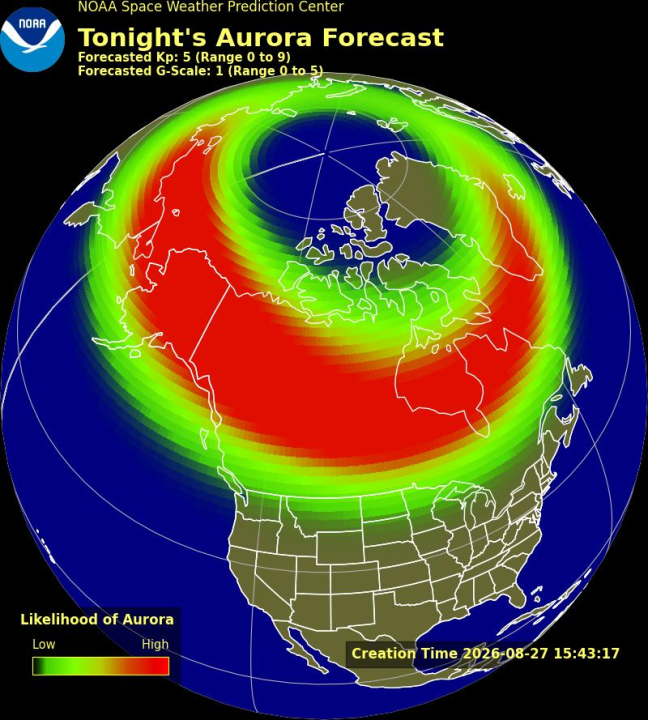
The upcoming week offers a chance to witness both a blood moon lunar eclipse and the northern lights, following intense solar activity. When the sun expels material that interacts with Earth’s atmosphere, the captivating northern lights may appear, sometimes accompanied by geomagnetic storms.
The National Weather Service’s Space Weather Prediction Center (SWPC) issued geomagnetic storm watches for Thursday and Friday due to the impact of a coronal hole high-speed stream (CH HSS). On Wednesday, watches were extended through Saturday in response to coronal mass ejections (CMEs) from the sun. These watches anticipate stronger conditions on Friday and Saturday, with the solar material potentially causing the northern lights in the northern U.S.
The SWPC’s three-day forecast predicts the geomagnetic storm conditions could escalate around 5 p.m. EDT on Thursday and continue past sunset, offering optimal viewing conditions for the northern lights at night. Conditions might reach a moderate G2 level between 8 p.m. and 11 p.m. EDT, enabling the northern lights to extend as far south as New York and Idaho.
The aurora forecast for Thursday grants Canada and Alaska the best chances for viewing the northern lights. People near the Canadian border could also view the aurora along the northern horizon.
The forecast indicates the storms may diminish as Thursday night turns into Friday morning, yet they could intensify again around 5 p.m. EDT. Conditions might strengthen once more between 8 p.m. and 11 p.m. EDT before fading. The forecast for Friday mirrors Thursday’s predictions.
The SWPC’s current forecast runs only until 11 p.m. EDT on Saturday, leaving uncertainty about further storms for viewing. Geomagnetic storm activity can vary in strength, and while predicting solar-material interaction with Earth’s atmosphere is challenging, optimal atmospheric conditions may not always lead to visible aurora.
If conditions are favorable, enhancing your chances to spot the aurora involves looking towards the northern horizon. Should you struggle to see the lights, using your phone’s camera might assist as digital lenses capture light more effectively, highlighting the aurora’s green, pink, and red hues.
Copyright 2026 Nexstar Media Inc. All rights reserved. This material is intended solely for informational purposes and should not be published, broadcast, rewritten, or redistributed.