
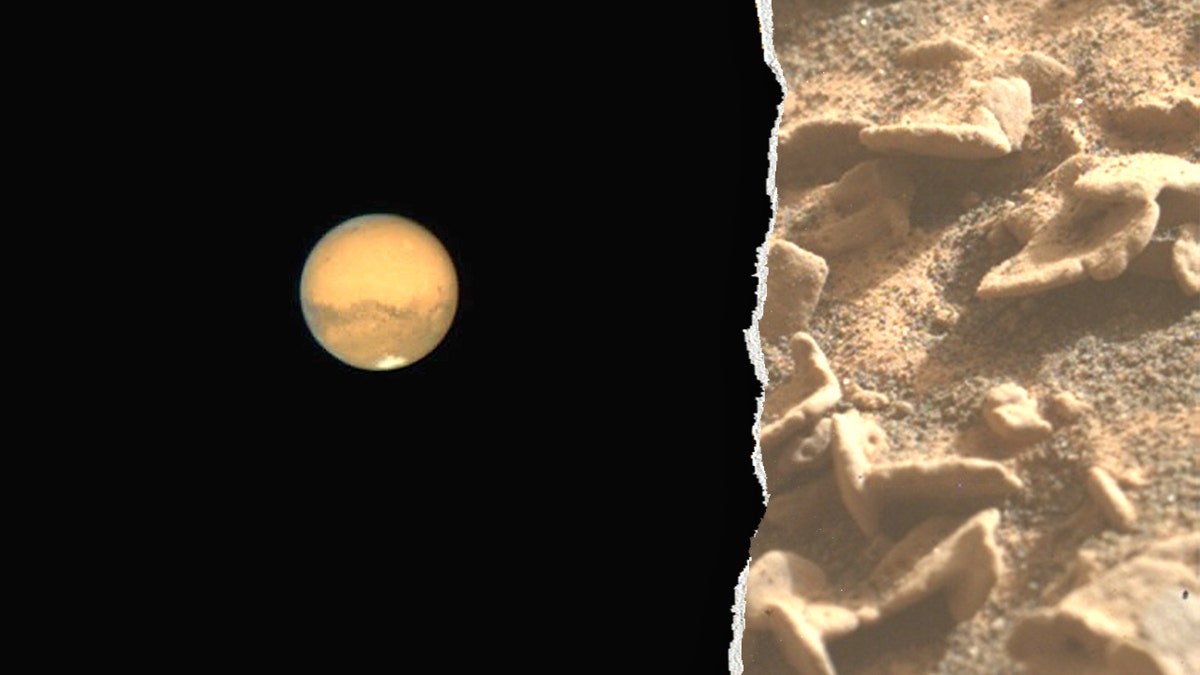
NASA scientists are examining unusual formations on Mars that resemble potato chips. These shapes are the focus of investigation as researchers try to understand how they formed and what their composition might be. This effort was detailed in a blog post on NASA’s ‘Curiosity’ website from November 11.
The Curiosity rover, launched in 2012, has been exploring Mars. It recently studied these formations during a drilling mission in a region nicknamed ‘Nazca.’ This drill site is known for its peculiar disk-like features in the bedrock.
This area contains bedrock with disk-shaped or potato chip-shaped crystal forms.
Images reveal curled formations within the rock, some resembling potato chips. One of NASA’s objectives is to characterize these formations more accurately.
Samples from the Nazca site were analyzed by Curiosity’s onboard laboratory, the Sample Analysis at Mars (SAM) instrument. The rover also planned to use the laser-equipped ChemCam to examine a formation called ‘Colca’ to analyze its chemical properties.
Nights were dedicated to photographing the formations using the Mars Hand Lens Imager (MAHLI) with white-light and ultraviolet LED lamps.
ChemCam LIBS observations were planned for each sol, including examining crystal clusters and layers in the Nazca block.
Once the analysis at Nazca was complete, the rover planned to continue its exploration further south on Mars.
In related space exploration news, astronomers recently identified a potential dwarf planet located beyond Pluto. Discovered using the Vera C. Rubin Observatory in Chile, the object named 2026 ED138 could be among the biggest dwarf planets found, measuring 370 to 930 miles in diameter.