
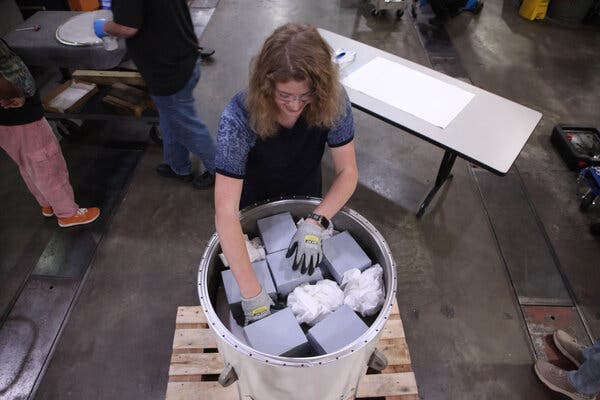
As the United States approaches its 250th anniversary, plans are underway for a significant celebration. Americans are engaging in various activities, including preparing to bury a collection of historical artifacts in a time capsule. This initiative is spearheaded by the federal government and is set to take place on July 4 at Independence National Historical Park in Philadelphia.
The time capsule aims to preserve objects and records from all 50 states and six territories. It will be encased in a cylindrical container weighing 900 pounds, covered with a 1,100-pound bell jar, and buried at a depth of at least eight feet. The goal is for the capsule to remain intact and undisturbed until 2276, 250 years from now.
The National Institute of Standards and Technology (NIST) has played a pivotal role in this project, using a multidisciplinary approach involving materials science, geometry, and physics. Michael Berilla, director of NIST’s fabrication technology office, led the project. He worked to ensure that the contents of the capsule remain preserved and in excellent condition over the long term.
The capsule’s diverse contents reflect the heritage and identity of each state and territory. For instance, Maine contributed a message engraved on whalebone, highlighting its maritime history. The Northern Mariana Islands included shells and necklaces, capturing elements of their culture. Arizona submitted a copper ingot, representing its status as the copper state. Ohio, the birthplace of the Wright brothers, added a piece of fabric from their first flight, acknowledging its aviation legacy.
This undertaking is not only a celebration of history but also an engineering challenge. The use of advanced materials and careful design aims to protect the capsule’s contents from environmental damage, including moisture and other potential threats. The hope is that future generations will uncover these treasures in excellent condition, gaining insights into the diverse cultural and historical aspects of 21st-century America.