
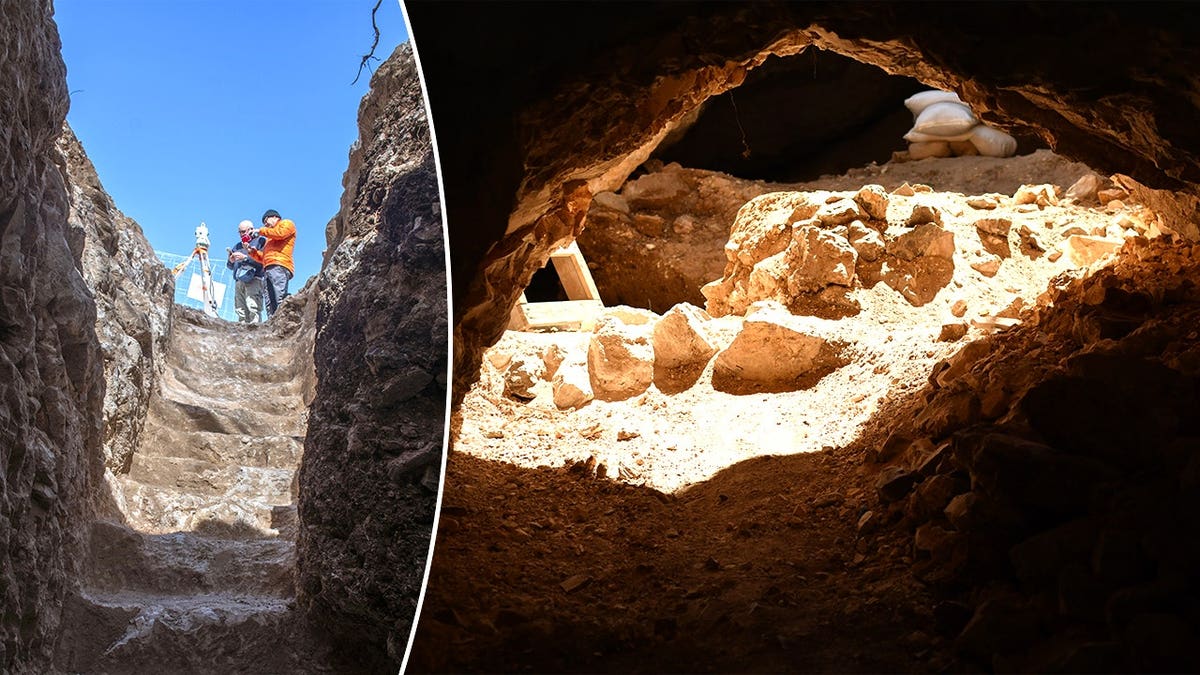
Recently, excavators revealed a “mysterious and impressive” ancient tunnel in Jerusalem. This discovery, announced by the Israel Antiquities Authority (IAA), is linked to archaeological sites from the biblical Kingdom of Judah.
The tunnel was found near Kibbutz Ramat Rachel, a location associated with the Kingdom of Judah. Previous excavations by the IAA had already highlighted this site’s historical significance.
Unearthing the Tunnel
Measuring approximately 164 feet in length, the rock-hewn tunnel emerged during preparations for a new residential area north of Ramat Rachel. The tunnel stands about 16 feet tall and 10 feet wide. According to officials, the rock-cutting was executed with precision.
“The tunnel was discovered filled with layers of soil that accumulated over hundreds, or perhaps thousands, of years,” the IAA stated. “The effort and careful planning involved in its construction indicate significant resources and capabilities.”
The tunnel’s discovery surprised excavation directors Sivan Mizrahi and Zinovi Matskevich, who were initially excavating in rocky terrain when they found a natural karstic cavity. “This cavity developed into a long tunnel,” they noted.
Historical Context and Theories
In 2020, IAA excavations near Ramat Rachel unearthed seal impressions and structures tied to the Kingdom of Judah, suggesting governmental activity. However, no current evidence directly links the newly discovered tunnel to the Kingdom of Judah or the biblical era. Its age remains unknown.
The tunnel lies a few hundred meters from two significant ancient sites: an Iron Age public building in Arnona and Tel Ramat Rachel, which showcases settlement remains from the Iron Age through the Islamic period.
Researchers theorize that the tunnel may have been carved to access a chalk layer for quarrying stones or producing lime. A shaft carved into the tunnel’s ceiling and quarrying debris on the floor could support this theory, though uncertainty persists.
Remaining Mysteries
Experts have discounted the idea that the tunnel was part of an ancient water system. It’s possible it was abandoned before completion, leaving its intended purpose and nature unclear. Researchers note that parts of the tunnel are still collapsed, obscuring further insights.
Amit Re’em, Jerusalem district archaeologist at the IAA, commented on the find. “This city never ceases to surprise,” he remarked, highlighting continuous discoveries throughout Jerusalem.
The tunnel might have connections to ancient quarrying activities involving chalk and building materials. As Re’em emphasized, “We often have explanations for our discoveries, but in this instance, we remain astonished and amazed.”