
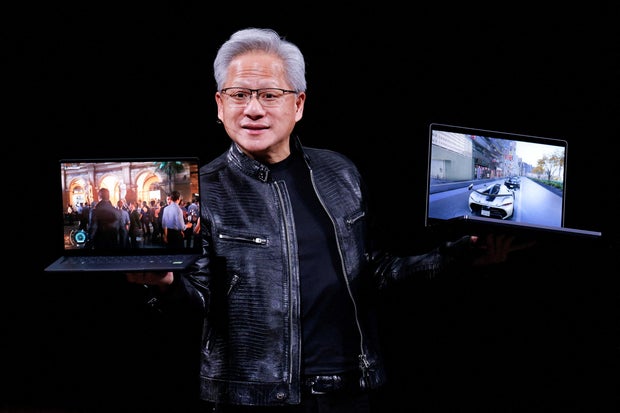
Nvidia unveiled its latest technological advancement on Monday, revealing new chips that will integrate advanced artificial intelligence (AI) capabilities into both laptops and desktop computers. These developments were announced at the annual Nvidia GTC event in Taipei, with Jensen Huang, founder and CEO of Nvidia, leading the presentation.
This move marks a significant step for Nvidia, a company based in Santa Clara, California, which has already achieved great success in supplying high-end chips for data centers. Nvidia’s new strategy aims to expand its AI presence across various systems and products. In collaboration with major brands like Microsoft and Dell, new computer models featuring these powerful chips are set to be released later in the year.
Huang expressed a bold vision for the future of personal computing, stating, “Microsoft and Nvidia are going to reinvent the PC.” He introduced Nvidia’s RTX Spark superchip, which merges CPU and GPU capabilities. These chips will power upcoming Windows laptops and desktop models, dubbed “AI personal computers,” expected to launch this fall.
Nvidia’s ambitious innovation positions it as the world’s most valuable company, surpassing other tech giants like Apple, Alphabet (Google’s parent company), and Microsoft. During his keynote speech at the Computex trade show in Taipei, Huang introduced laptop models featuring RTX Spark GPUs.
This technological leap allows for an autonomous AI agent that can interact with users by understanding speech, conducting file reading, and performing research tasks. Huang likened this development to the transformation of mobile phones into the smartphones we know today.
Nvidia’s investment in AI-driven computing will target specific functions such as digital biology, seismic processing, and astrophysics. Microsoft affirmed that computers equipped with Nvidia’s RTX superchips will support sophisticated AI models and manage complex workloads. These capabilities enable AI agents to operate locally on the devices.
Lian Jye Su, chief analyst at Omdia, highlighted the significance of Nvidia’s move, noting increased consumer choices. Neil Shah, co-founder of Counterpoint Research, described the announcement as a revolutionary change for PCs over the next decade. The new devices aim to make agentic AI applications commonplace in households, transforming each into an ‘AI supercomputer.’
In his presentation, Huang also announced the full production of new Vera CPUs for data centers. This product is set to become a major growth driver, with early adopters including Anthropic, OpenAI, and SpaceXAI. Additionally, Nvidia showcased a humanoid robot reference design, offering a blueprint for future research, particularly in higher education.