
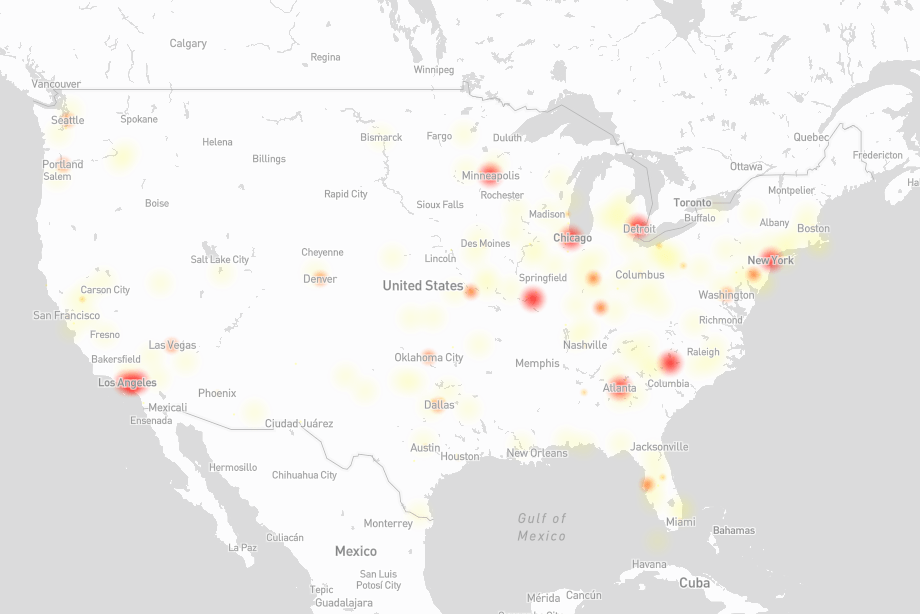
On Monday afternoon, users of T-Mobile and Verizon experienced difficulties using their phones, citing a widespread outage. Many users reported receiving SOS messages, indicating a lack of service. By 8:40 p.m. ET, the number of reported issues had decreased to under 7,000 from a peak of over 60,000 around 5:06 p.m. ET for T-Mobile, according to DownDetector.
Outage Distribution
A heat map identified the largest concentration of complaints originating from major cities such as New York City, Columbia, South Carolina, Springfield, Ohio, Chicago, Detroit, and Minneapolis. In addition, Verizon also had users reporting problems, albeit to a lesser extent than T-Mobile.
Verizon stated on the platform X, “Our network is operating normally nationwide. If you’re having trouble reaching someone, it may be due to the reported outage on T-Mobile’s network.” AT&T users saw similar increases in reports, which subsided quickly. T-Mobile communicated via X, “Our teams are actively working on the reports of technical challenges impacting some customers. Any service impacts are in the process of being resolved. We know how critical it is to stay connected and every available resource is focused on resolving this as quickly as possible.” Newsweek reached out to both T-Mobile and Verizon but did not receive responses in time for publication.
Understanding SOS Alerts
Many users saw “SOS” or “SOS Only” on their iPhones, signifying the device was not linked to its usual network but could still make emergency calls through available alternate carriers. This feature functions as a safety measure, ensuring emergency services can be reached even when normal service is disrupted. This alert appears when there is poor reception, a carrier outage, or issues with the SIM card or network settings. Regular calls, texts, and mobile data are typically unavailable until the phone reconnects to its primary network.
T-Mobile and Verizon Outage Maps
DownDetector’s map shows significant outages in cities including Seattle, West Sacramento, California, Irvine, California, Albuquerque, Orlando, and St. Louis.
The map for Verizon indicated clusters of complaints across the U.S. over the past 24 hours. These maps highlight significant disruptions, identifying areas with the most concentrated reports. DownDetector flags incidents when complaint volumes exceed typical levels, hinting at potential service disruptions.
Expert Insights
Roger Entner, an analyst at Recon Analytics, provided his perspective to Newsweek. He explained that a nationwide disruption usually points to core network issues, often related to cascading upgrades through the network. He mentioned that third-party routing impacts connections between carriers, noting phones might be disconnected from the network without triggering widespread alerts. He elaborated on how T-Mobile engineers likely focused on identifying changes and preventing further spread during the initial triage window. Networks are predominantly software-based now, akin to computers, and engineers work to roll back recent changes.
For consumers, differentiating between localized and core network outages can be challenging as both result in phones failing to connect. Network outages prompt user activity spikes in outage services like DownDetector.
Entner noted that while these outages occur infrequently, they impact all carriers occasionally. “Every carrier has infrequent outages. Happens every few years, but is uncommon,” he affirmed.