
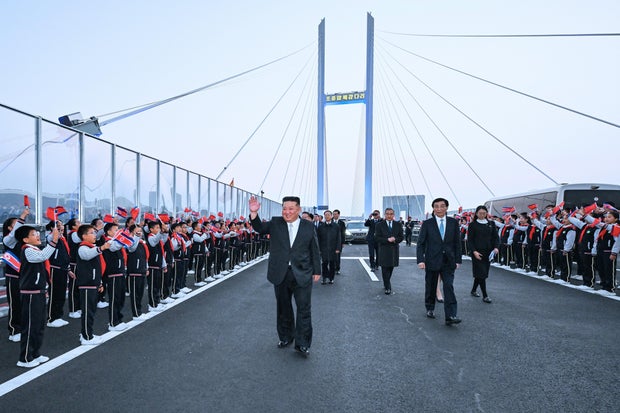
North Korean leader Kim Jong Un visited China on Saturday to inaugurate a new bridge connecting the two countries. He expressed a commitment to enhancing cooperation with China, a key ally. This visit marks another step in Kim’s foreign policy strategy, aiming to strengthen alliances with Beijing and Moscow against the United States, which he describes as part of a ‘new Cold War.’
Kim arrived in the Chinese city of Dandong after crossing the newly opened bridge. This visit was confirmed by both South Korea’s Unification Ministry and China’s official Xinhua News Agency. During a ceremony at the Yalu River Bridge, where he was accompanied by Chinese Foreign Minister Wang Yi, Kim emphasized the strong ties between North Korea and China.
“We will firmly carry forward the invincible DPRK-China friendship forged at the cost of blood all the time,” Kim declared at a memorial in Dandong, which honors China’s support during the 1950-53 Korean War, according to North Korea’s Korean Central News Agency (KCNA).
While in Dandong, Kim met with Wang Huning, a member of the Standing Committee of China’s Communist Party. During their meeting, Kim reaffirmed his commitment to developing bilateral cooperation. Wang conveyed greetings from Chinese President Xi Jinping and noted the importance of Kim’s visit in strengthening their longstanding friendship.
The visit also included a tour of a local car factory. Afterward, Wang accompanied Kim to the bridge for his departure. Upon returning home across the bridge, Kim commented on its historical mission to link the two countries and unite their peoples.
In recent years, Kim has focused on strengthening ties with China. China has been North Korea’s main ally and economic supporter. North Korea has sent troops and weapons to aid Russian President Vladimir Putin’s war in Ukraine, possibly in exchange for military and economic support.
Kim’s last visit to Beijing was in September 2025, when he met with Xi Jinping and attended a military parade alongside Russian President Putin and other international leaders.