
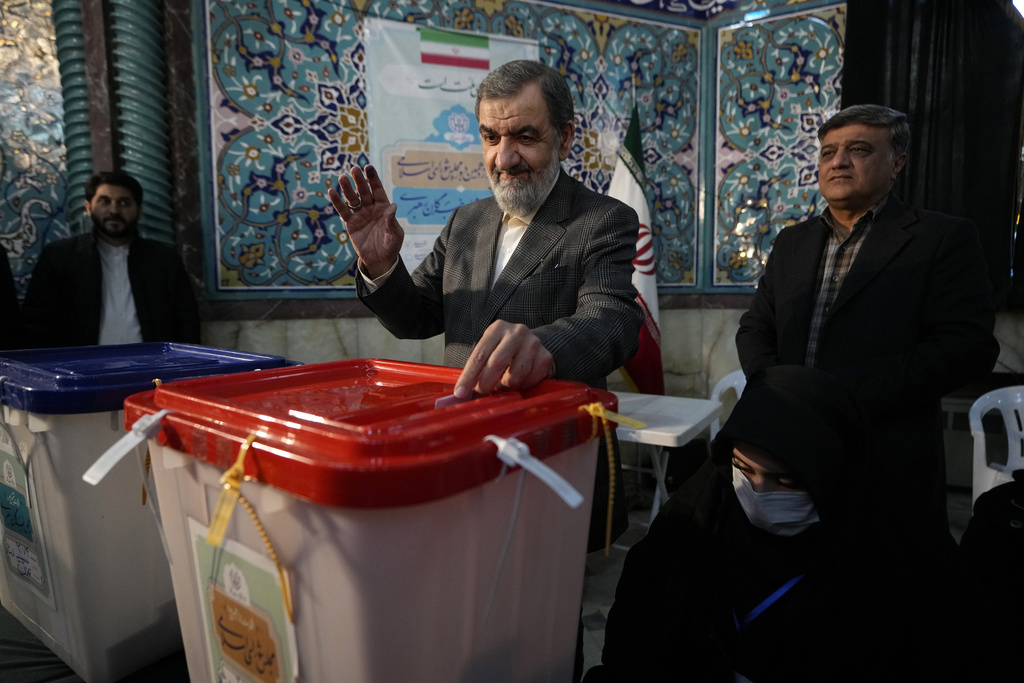
Mohsen Rezaei, former Islamic Revolutionary Guard commander, participated in Iran’s parliamentary and Assembly of Experts elections in Tehran on March 1, 2024. This came amid U.S. President Trump’s softened stance regarding Iran. A week earlier, he was on the brink of renewing combat operations, yet recently emphasized economic pressure over new strikes in an interview with Axios.
Trump’s remarks included observations on Iran’s economic struggles, suggesting a passive approach rather than direct confrontation. He likened the situation to a chess game. His approach seems evasive, relying on patience and a belief that things will eventually resolve, lacking a clear timeframe.
Tehran responded. Mohammad Bagher Zolghadr, while serving as secretary of Iran’s Supreme National Security Council, outlined six conditions for reopening the Strait of Hormuz. These included ending U.S. threats, stopping attacks on Iran-aligned groups, lifting the naval blockade, compensating for wars, lifting sanctions, and releasing frozen assets. This escalated Strait negotiations to a political resolution of the war.
The situation intensified when the UAE accused Iran of firing a missile at an ADNOC-owned tanker in the Strait. Oman, involved in separate shipping talks, condemned the attack, warning it could affect negotiations. Iran’s Foreign Minister Abbas Araghchi denied ongoing negotiations with the U.S., contradicting Trump’s assertions of positive discussions.
Leadership changes in Iran have further complicated matters. Reports surfaced that Mohsen Rezaei might succeed Zolghadr as secretary of the Supreme National Security Council. Despite initial denials and rearrangements, the succession was confirmed, with Rezaei taking multiple roles. This change hints at a hard-line faction consolidating power over negotiations, though the leadership structure remains unsettled.
Since Israeli forces killed Ali Larijani in March, Iran’s leadership dynamics have lacked clarity. Rezaei, a significant figure with ties to Mojtaba Khamenei, has now assumed key roles in security policy. Speculation suggests Araghchi may have been sidelined, subordinating Iran’s diplomatic efforts to security interests.
The repositioning indicates Tehran prioritizes security over diplomacy amid U.S. economic pressures. Iran seems to be raising its negotiation stakes, driven by recent leadership changes. The primary concern is determining which Iranian authority can engage with Washington’s terms.
Charbel A. Antoun specializes in U.S. foreign policy, focusing on the Middle East and North Africa. © 2026 Nexstar Media Inc.