
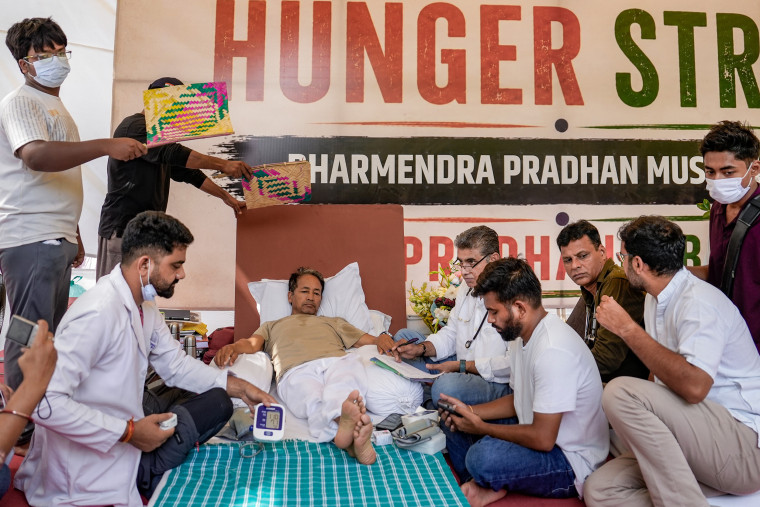
Supporters of India’s youth-led “cockroach” movement encountered police action Monday as they attempted to approach the parliament in New Delhi. Authorities had not granted permission for the protest.
The movement and the planned protest represent a significant public challenge to Prime Minister Narendra Modi during his third term. It has garnered substantial support on social media, broadening its reach.
The movement gained momentum after activist Sonam Wangchuk, who was on a hunger strike, was moved to a hospital by the police on Saturday. Thousands of supporters assembled overnight at Jantar Mantar in central New Delhi for the march on the opening day of the monsoon session in parliament.
Delhi police engaged in discussions with the Cockroach Janta Party (CJP) members, yet no agreement was reached, according to Sachin Sharma, Delhi’s deputy commissioner of police.
“The protest site has already run out of space and this can lead to an untoward situation,” he noted, stating that around 10,000 protesters were present on Monday morning.
Security forces, including police and paramilitary personnel, were deployed at the site. The scenario indicated a potential standoff near parliament if the march proceeded. Television footage depicted police using canes against some protesters in a heavily secured area.
Delhi Police refuted claims of using force, asserting that the “protest is being handled professionally.” Protesters, undeterred by rain, chanted slogans aimed at the prime minister and other officials.
Saurav Das, the chief spokesperson for the CJP, expressed a willingness to engage with the government, even though discussions began late.
The CJP movement originated following the leak of national medical school entrance test papers in May, affecting over 2 million students and resulting in a retest.
Many young individuals like Adi Nathan, a 21-year-old student from Meerut, joined the protest to demand accountability and end paper leaks.
Mohammed Tabrez, another student from Amroha, emphasized the need to address corruption in examinations.
Initially, the CJP found support online, attracting 22 million Instagram followers rapidly. Opposition parties have also shown support.
CJP founder Abhijeet Dipke commenced a sit-in last month, demanding the resignation of Education Minister Dharmendra Pradhan. Wangchuk joined with an indefinite hunger strike beginning June 28.
From his hospital bed, Wangchuk indicated on social media that his fast would conclude if the government acknowledged its failures or if protesters were allowed to present their issues before parliament.
“I would also end the hunger strike if lawmakers meet me in the hospital and provide necessary assurances,” Wangchuk stated.
The emergence of the CJP underscores the frustration of young Indians with issues like paper leaks and high youth unemployment. Data indicates that unemployment was 9.9% among those aged 15 to 29 in 2025, with urban areas experiencing a rate of 13.6%.