
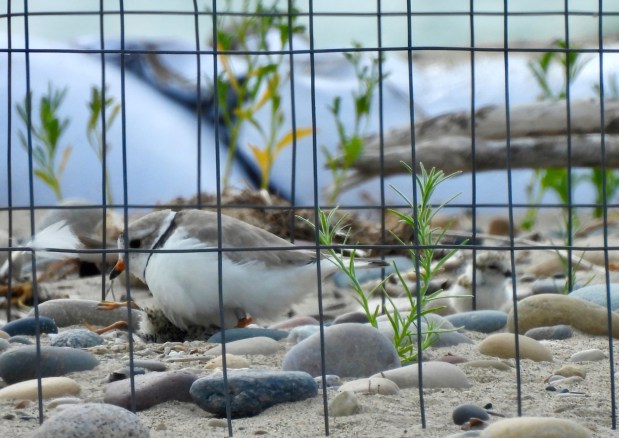
The Waukegan shoreline welcomed new members to its piping plover population this week. Three chicks were released, coinciding with the naming and banding of three resident piping plovers. This update came from the Lake County Audubon Society.
Carolyn Lueck, president of the Lake County Audubon Society, expressed excitement about the addition. “It was very exciting to get the news that they were going to bring us three siblings: two females and a male,” she stated. The release coordinated with the banding of local wild-fledged birds.
The resident plovers received names: Dune, Pebbles, and Drifter. These names are inspired by the Great Lakes region; “Drifter” is derived from “driftwood.” Lueck explained that the bird was initially to be named “Drift,” but was changed due to its explorative nature. “Since he (or she) first was hatched and then an hour later started exploring, he’s just kind of been the adventurer,” Lueck noted.
Chicks were raised by Pepper and Blaze, familiar faces at Lake County beach. The three released plovers were raised in captivity at the University of Michigan Biological Station. These include two females, Amaura and Anorith, and a male, Archen, all named after Pokémon franchise creatures. Lueck explained the names help draw interest from diverse crowds. “Let’s just say there might be some piping plover trading cards in our future,” she suggested.
In July 2026, a newly hatched piping plover chick nestled under Pepper for warmth in Waukegan. Their genders remain unknown until potential return next year, when sex-distinct features like forehead band variations will develop, Lueck said.
Other visitors to Waukegan include Frankie and Buddy, siblings hatched at Montrose Beach this year. They descend from Monty and Rose, pivotal in a conservation movement in Chicago by successfully raising chicks after more than 70 years.
The Lake County Audubon Society aims to promote piping plover awareness to conserve habitats supporting diverse wildlife. “The more we can get the word out about these precious little birds, the better it is for a lot of different things,” Lueck added.