
Reykjavik, Iceland — Citizens in Iceland voted recently on the prospect of reopening talks to join the European Union. The decision highlights divisions over living costs, security, sovereignty, and fishing rights.
The outcome remains uncertain. A Gallup poll indicated a slim majority against resuming negotiations, a change from previous surveys showing a narrow lead for those in favor.
Arguments For and Against
Proponents of EU talks argue that joining could alleviate high interest rates and enhance security amidst global instability. The conflict in Ukraine and U.S. President Donald Trump’s comments on Greenland add to the tensions.
Opponents fear EU membership may undermine Iceland’s sovereignty and control over fishing waters. Iceland’s former President, Ólafur Ragnar Grímsson, expressed these concerns on social media.
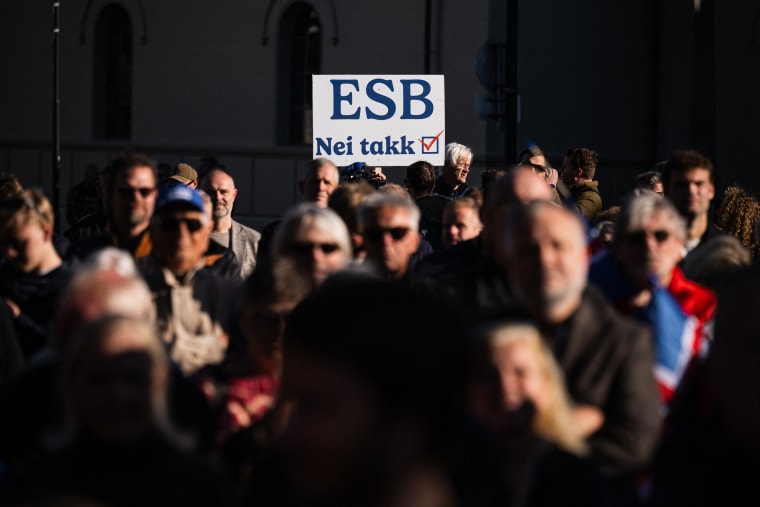
A supporter of the ‘No’ campaign demonstrated their stance publicly during a rally against resuming EU membership discussions in Reykjavik.
Procedure and Context
If voters approve reopening negotiations, this would initiate discussions with Brussels. A subsequent referendum would then determine Iceland’s EU membership.
The EU, one of the world’s largest trading blocs, found Iceland among the few European states remaining outside its fold, along with Norway and Switzerland. Meanwhile, the U.K. exited the EU after a 2016 referendum.
Historical Context and Current Debates
Iceland’s initial EU application came in 2009 during an economic crisis. Talks ceased in 2013 under a Eurosceptic administration. Renewed geopolitical tensions have prompted fresh debates.
Foreign Minister Thorgerdur Katrin Gunnarsdottir supports reopening talks, emphasizing that global upheavals necessitate reassessing Iceland’s stance.
Economic and Fishing Concerns
Discussions in Iceland have centered around economic issues, notably inflation and high interest rates impacting mortgages. Advocates for joining the EU suggest potential economic benefits from both membership and possible euro adoption.
Chief economist Vilhjalmur Hilmarsson of Viska sees EU membership as a possible path to economic improvement. However, opposition leader Guðrún Hafsteinsdóttir contends the economic rationale is overstated, asserting domestic politicians should address these challenges.
The EU’s quota rules on fishing remain contentious. Opponents doubt the EU would allow Iceland to maintain full control over its waters.
A Foreign Ministry memo anticipates that if voters approve, accession talks might commence by late 2026 and conclude in about two years. However, an impending general election by November 2028 introduces further uncertainty.
Polling stations in Iceland were set to close at 6 p.m. ET, reflecting the deep national interest in the outcome.