
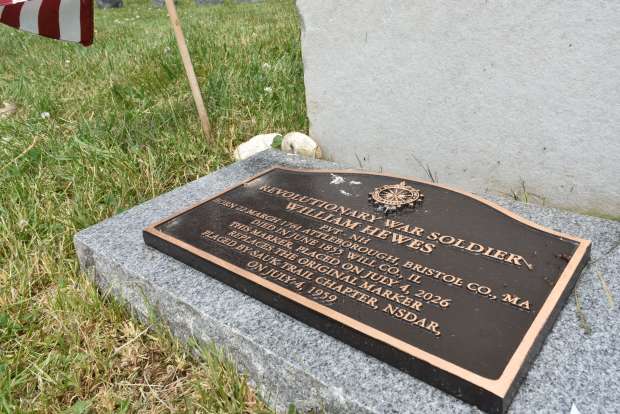
William Hewes was born in 1761, before the United States of America existed. By the time he passed away in 1855, the tension over slavery threatened the nation. In those 94 years, Hewes donned a uniform, fought against the British, contributed to nation-building, and eventually moved west with his family, settling in Crete, Illinois. Today, 29 of his descendants call Crete home.
Recently, a ceremony was held in Will County to rededicate a plaque at Hewes’ grave in Crete. Organized by the National Society Daughters of the American Revolution, a group of about 36 people, including descendants and local historians, gathered to honor his memory. The original plaque was dedicated in 1959 but required replacement due to aging.
Melody Paris-Rush, a DAR regent, explained that the 250th anniversary of the nation provided a fitting occasion for the ceremony. She noted that the original marker had deteriorated over time due to weather and maintenance. The new metal plaque highlights Hewes’ participation in the Revolutionary War and records his birth and death in Massachusetts and Illinois, respectively.
Tim DeMuth, one of Hewes’ descendants, spoke at the ceremony at the nearby First Congregational Church. He recounted Hewes’ service in the Revolutionary War. Hewes enlisted at 18, and during those months, he witnessed significant events such as the hanging of John Andre, who conspired with Benedict Arnold.
Though not a famous soldier, Hewes contributed alongside many others to secure American liberty. DeMuth emphasized the collective effort required to win the war and maintain the nation’s freedom.
After his service, Hewes traveled via the Erie Canal and Great Lakes, arriving in Detroit before heading further west to Crete. Despite his age, he journeyed with his son and established roots in Illinois. Five of Hewes’ 12 children settled in Crete, founding families who became politicians, ministers, farmers, and shopkeepers.
Many of his descendants remain in Crete, residing in homes passed down through five generations. As DeMuth said, the land is intertwined with their family’s identity and spirit.