
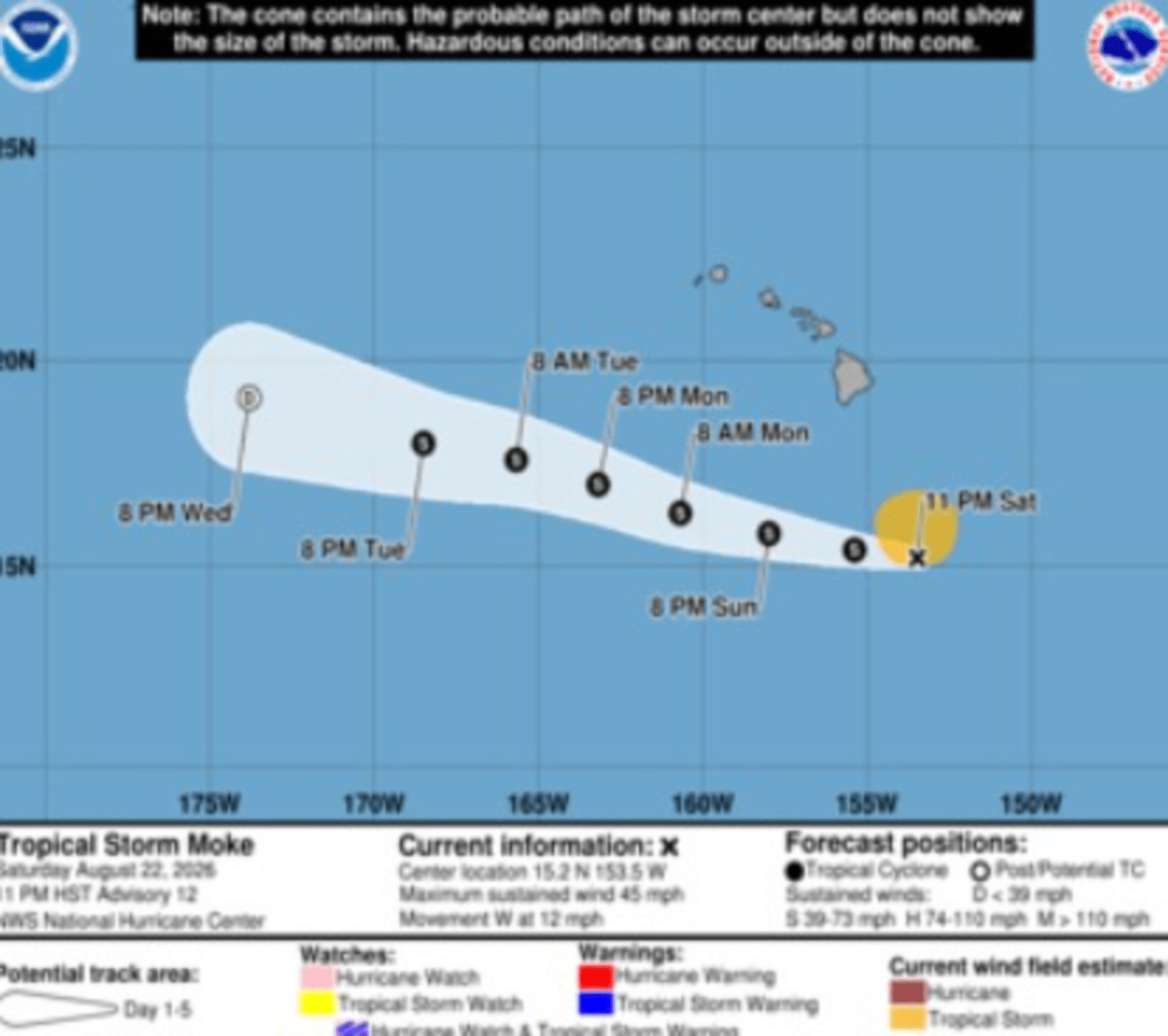
Hawaii is bracing for potentially life-threatening flooding as Tropical Storm Moke impacts the state, following recent damage caused by Tropical Storm Lala. The National Hurricane Center (NHC) reports winds reaching 45 mph on Saturday evening, predicting the storm’s center will pass south of the Big Island on Sunday and continue south of other islands next week.
Heavy rainfall is anticipated to impact the Big Island early Sunday and progress westward throughout the day. Weather projections from windy.com show rainfall ranging from 5 to 10 inches, with some areas expecting up to 15 inches. Eastern Maui is predicted to see 3 to 6 inches, while other islands may experience 1 to 2 inches of rain.
This rainfall may produce life-threatening flooding and mudslides for the windward and southeast regions of the Big Island, particularly in steep terrain and areas affected by Lala,
the NHC stated in its advisory at 11 p.m. on Saturday. Although the strongest winds from Moke are expected to pass to the south, gusty winds are likely, especially near and downslope of higher terrain.
Maui County Mayor Richard Bissen highlighted the impacts of Tropical Storm Lala. Even moderate rain and wind could trigger flooding, debris, power outages, and road issues. Maui County officials and community members are urged to prepare accordingly.
The warning follows Tropical Storm Lala’s early impact this month, marking the second named storm in the Central Pacific and the ninth in the Pacific basin for 2026. Lala caused heavy rains and winds over Hawaii, with rainfall totals reaching 3.5 feet in some areas over 48 hours. The storm damaged or swept away approximately 100 homes, six bridges, and left over 100,000 people without power, causing significant financial damage. Governor Josh Green reported one fatality from a weather-related car accident.
On the day of Lala’s impact, Randy Collins, Hawaii’s emergency management director, acknowledged the risks associated with cleanup operations, including the use of heavy equipment. Previously, Hawaii faced a threat from Hurricane Fausto in July, which weakened before moving north of the island.
Bissen noted ongoing storm fatigue among residents still recovering from previous weather systems. The rainfall from Moke may not be as intense as that from Lala but remains dangerous due to saturated ground conditions.
2026 Hurricane Season Overview
Since 1992, Hawaii has not experienced direct hurricane landfall since Hurricane Iniki. Earlier this month, Hurricane Lala’s eye passed 30 miles off the Big Island’s coast as a Category 1 hurricane. Hawaii typically avoids tropical cyclones due to cooler sea-surface temperatures. However, this year’s extended El Niño pattern has warmed ocean waters, enhancing cyclone development.
Tropical Storm Arthur marked the beginning of the 2026 Atlantic hurricane season in mid-June, bringing heavy rainfall and flooding to the U.S. Gulf Coast. As of mid-August, fewer named storms have developed, with no hurricanes forming, according to the NHC. The season is presently below the long-term average, although peak season typically occurs in September.