
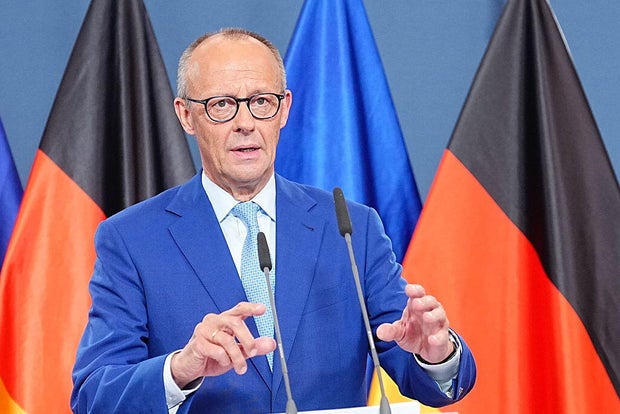
German Chancellor Friedrich Merz maintained his stance on Sunday, committing to continue with reforms for Europe’s largest economy. His resolve comes after significant electoral losses in two state elections. Exit polls from ARD, a public broadcaster, showed the center-right Christian Democratic Union (CDU) securing only 5% of the vote in Mecklenburg-Western Pomerania. This is the lowest result for the party in any state since World War II.
The far-right Alternative for Germany (AfD) party gained ground. Merz described the results as a “disaster,” yet he insisted on following through with his government’s reform agenda. He emphasized that Germany’s economic and political issues necessitate difficult reforms, making them more pressing despite their potential unpopularity.
Speaking at the Konrad Adenauer House after the elections in Berlin and Mecklenburg-Western Pomerania, Merz stated, “What needs to be done now requires backbone, steadfastness, and patience. I will demonstrate these qualities as chairman of the CDU and, above all, as chancellor of our country.” In Berlin, CDU was projected to take second place with 20%, behind Die Linke (The Left Party), which achieved 24.5%, according to ARD’s exit poll.
“In our city, love and justice have triumphed over hatred,” said Elif Eralp, Die Linke’s lead candidate and the daughter of Turkish migrants, celebrating her party’s victory over AfD.
Merz’s leadership was already compromised by the CDU’s defeat to AfD in the Saxony-Anhalt election on September 6. The outcome shocked many Germans who believed their country had overcome nationalism and racial superiority through education and strict laws against persecution. On Sunday, AfD was projected to make notable gains in both states, securing 37% in Mecklenburg-Western Pomerania and 15.7% in Berlin. However, they were far from forming a regional government.
AfD’s national co-leader, Tino Chrupalla, criticized Merz on ZDF television, saying, “the chancellor’s statement today was more than feeble — he announced that he’d carry on as before, instead of finally drawing the consequences and resigning.”
In response, Merz implied that his government’s reforms would counter the growing allure of authoritarianism. The CDU has led Germany’s government for much of its post-war history. Merz, 70, took office 16 months ago, aiming to revitalize an economy that has experienced minimal growth. However, his government has struggled with economic weakness, causing disillusionment among voters who expected swift financial and tax reforms.
Although Germany is experiencing moderate growth again, the labor market worsened last year. Over 3 million people were unemployed in August, marking an increase of 36,000 from the previous year, as per the Federal Employment Agency. The labor demand remains weak.
The AfD’s strong performance in the Saxony-Anhalt election, where it has a close chance of establishing Germany’s first far-right regional government since World War II, has further challenged Merz’s national standing. Recent weeks have seen calls, including from within his party, for his replacement as chancellor. However, no top-level allies have publicly demanded his removal, and many caution against internal debates over leadership.
In anticipation of a challenging period following the election, Merz canceled a planned trip to New York for the U.N. General Assembly. Despite these challenges, he remains determined to complete his term as chancellor.