
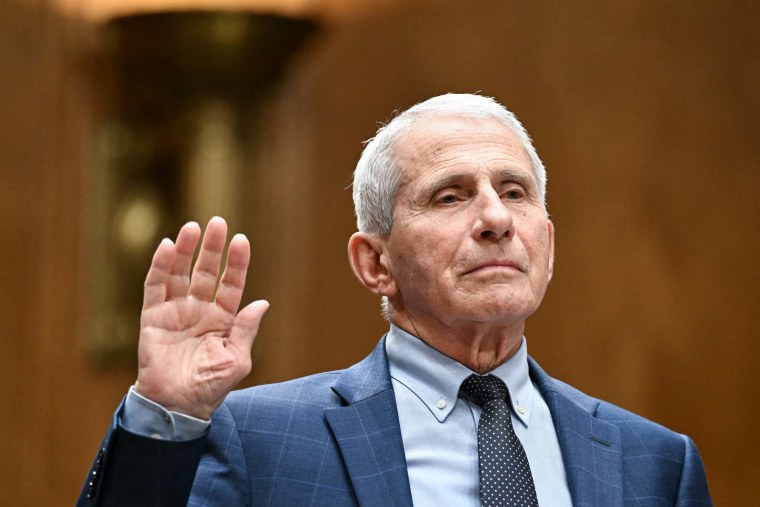
Dr. Anthony Fauci chose not to answer questions from senators during a hearing on Wednesday about the origins of Covid-19 and the government’s response to the pandemic. He stated that he would exercise his Fifth Amendment right to avoid the possibility of Republicans using his testimony against him for perjury.
The decision caught attendees by surprise, especially given the contentious nature anticipated due to Fauci’s previous disagreements with Chairman Rand Paul, R-Ky. In his opening remarks to the Senate Homeland Security and Governmental Affairs Committee, Fauci mentioned Paul’s fixation on seeking his prosecution and Paul’s release of his personal journal.
“The only conclusion I can reach is that the sole reason he is calling me before this committee is to get me to say something — anything — that could vindicate his repeated public pledges that I end up, in his words — quote — ‘behind bars,’” Fauci said.
Fauci explained that his decision was not easy due to his respect for the legislative process. However, his attorneys advised him to safeguard his rights. He had testified for Congress over 200 times during his tenure as the director of the National Institute of Allergy and Infectious Diseases.
Despite Fauci’s refusal, Paul proceeded to ask questions, to which Fauci consistently replied, “On the advice of counsel, I respectfully decline to answer based upon my rights under the 5th Amendment to the Constitution.” Paul commented that Fauci would face consequences for not complying with the committee’s directions, suggesting repercussions could follow.
During the hearing, Fauci’s lawyer attempted to speak but was silenced by Paul, leading to the lawyer’s removal from the room. Later, the attorney confirmed Fauci’s right to invoke the Fifth Amendment, asserting his privilege.
Senator Gary Peters, D-Mich., criticized the hearing’s conduct, suggesting it could deter future scientific experts from public service. Likewise, Senator Richard Blumenthal, D-Conn., opted not to question Fauci and instead condemned the hearing as unfair prosecution.
Paul had previously accused Fauci of lying to Congress, a claim Fauci denies. The senator argued that there is no risk of perjury when telling the truth, but suggested Fauci could admit to past errors as long as he did not lie again. A preemptive pardon for Fauci issued by former President Joe Biden was also mentioned as a potential point of contention.
David Schertler, Fauci’s attorney, noted that due to the hostile environment, Fauci could no longer cooperate. Schertler highlighted Paul’s alleged vendetta against Fauci, which has led to threats against him and his family. The attorney reaffirmed Fauci’s commitment to public health and challenged the factual basis of Paul’s accusations.