
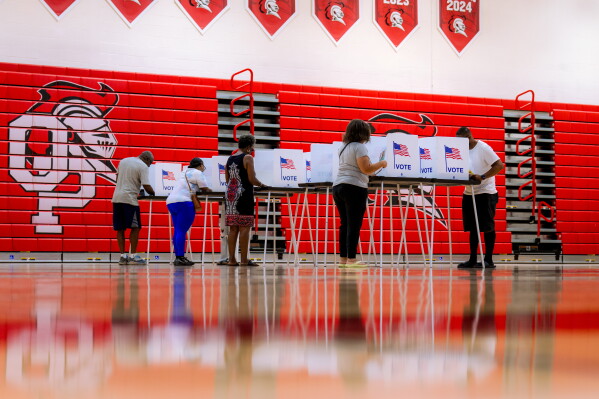
Democratic voters are participating in primaries this year in numbers not seen for decades. This trend is appearing across several states, giving the party hope for the upcoming November elections, where control of Congress will be at stake. In Wisconsin’s recent primary, nearly 800,000 Democrats cast ballots, their highest midterm turnout in over 20 years. Similarly, Michigan saw 1.5 million Democratic voters the previous week, marking a midterm record for the state.
The enthusiasm is not limited to the Midwest. Earlier this year, states like Texas and Georgia also recorded increased Democratic turnout. These states are expected to have competitive Senate races this fall. This pattern of strong Democratic showings is encouraging, especially considering the typical disadvantage for the president’s party in midterms. This year’s context includes President Donald Trump’s low approval ratings, persistent inflation, and an unpopular war with Iran.
“The big news is that Democrats are seeing large turnouts,” said David Axelrod, former adviser to Democratic President Barack Obama. Competitive Democratic primaries have motivated voter participation, unlike Republican primaries, which have seen turnout closer to historical norms.
Voter turnout in primaries does not perfectly predict general election outcomes, especially when one party offers more compelling early contests. Republican leaders plan to mobilize their voters this fall through strategic efforts, including leveraging a fundraising advantage and Trump’s campaigning at a midterm convention in Texas next month.
“Primary turnout doesn’t win general elections,” stated Mike Marinella, spokesman for the National Republican Congressional Committee. “House Republicans are entering November with money, momentum, stronger candidates, and a well-prepared operation to turn out voters when it counts.”
In Wisconsin, over 790,000 people voted in the Democratic primary for governor, representing about 22% of registered voters. In Michigan, more than 1.5 million participated in the Senate primary, reflecting 18% of registered voters. This was the highest Democratic primary turnout in a Michigan midterm since 2002, matching Wisconsin’s rate, according to Associated Press election data analysis.
In Minnesota, Democratic primary turnout equaled that of the 2018 midterm, marking the state’s highest Democratic turnout in a midterm year this century. Republican turnout in Wisconsin and Michigan remained consistent with previous midterms.
Other states’ earlier elections also showed significant Democratic turnout. In Georgia, over 1 million voted in the Democratic governor’s primary, about 13% of registered voters. In Texas, approximately 2.3 million participated in the Democratic Senate primary, over 12% of registered voters.
According to Corwin Smidt, a political science professor at Michigan State University, the robust primary turnout is promising for Democrats but not a solid predictor for November outcomes. He noted that recent high turnouts have increased the pool of regular voters, as voting is habit-forming.
States with high turnout featured “media spotlight candidacies,” such as progressive versus moderate races in Michigan, Wisconsin, and Minnesota. Michigan’s Democratic Senate primary spending exceeded $80 million. Progressive Abdul El-Sayed narrowly defeated Rep. Haley Stevens, drawing attention and energizing younger and university voters. However, Stevens’ supporters, who helped carry Wayne County, expressed hesitation about supporting El-Sayed if he won.
In Wisconsin, the governor’s primary shifted repeatedly as moderate Democrats adjusted their campaigns. Francesca Hong, a democratic socialist, consolidated progressive support but lost narrowly to Milwaukee County Executive David Crowley, a moderate. These races demonstrate how competitive primaries generated attention and how candidates must unite their party for November. Wisconsin and Michigan Democrats held unity breakfasts following the primaries.
Senator Bernie Sanders expressed confidence that Democratic voters will reconcile for the general election. He emphasized that unity is essential for taking on Trump and creating a Democratic majority in both chambers.
While Democrats have reasons for optimism, they face challenges with the current congressional map, which has become more favorable to Republicans. Several Republican-controlled states redrew congressional districts to benefit the GOP, following Trump’s direction. Although some Democratic-controlled states responded, Republicans expect net benefits due to their slim House majority.
Presently, Republicans control the Senate with 53 seats against the Democrats’ 47. Democrats need to gain four seats for a majority. Smidt highlighted that Democrats must generate enthusiasm similar to Republicans in 2024 to alter the electoral map significantly.
___
Pamela Jo Martin and Samuel Jens from The Associated Press Election Services team contributed to this report from Washington.