
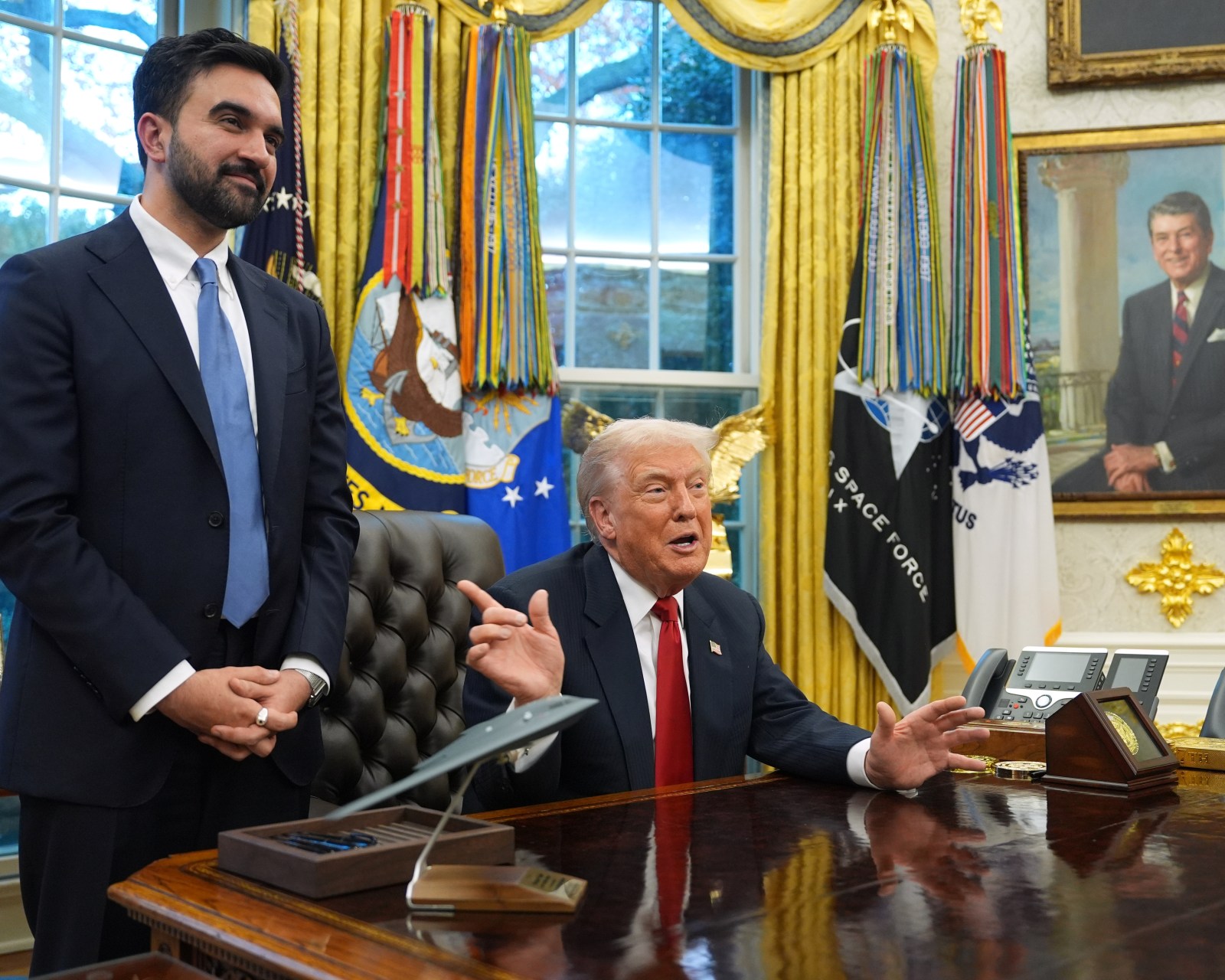
President Donald Trump shows a more favorable net favorability rating than New York City Mayor Zohran Mamdani, based on a recent Harvard CAPS/Harris poll. Despite this, both figures maintain negative perceptions among voters as key representatives of their political parties.
The poll indicates Trump has a net favorability rating of -8%, with 42% of registered voters viewing him positively and 50% unfavorably. In contrast, Mamdani has a net favorability of -14%, with 25% viewing him favorably and 39% unfavorably. Conducted from August 28-30, 2026, the survey included 2,100 registered voters and has a margin of error of 2.1%.
These statistics highlight the prominence of Trump and Mamdani as leaders of the Republican and Democratic parties, respectively. Trump has shaped the GOP around his Make America Great Again (MAGA) movement. In parallel, Mamdani’s swift rise as a significant figure reflects a major shift within the Democratic Party’s progressive wing. Both have become pivotal in discussions about party direction.
The Harvard CAPS/Harris Poll further reveals that 51% of voters perceive the Democratic Party as being overtaken by the far left, while 45% see the Republican Party as dominated by the far right.
Mamdani’s unexpected victory over establishment Democrat Andrew Cuomo in New York’s mayoral primary has positioned him as a national figure, sparking debate among Democrats about whether to adopt his progressive politics. Meanwhile, Trump’s influence also presents complexities for Republicans trying to distance themselves from his agenda.
This scenario creates a political paradox. Both Trump and Mamdani are central to America’s polarizing political environment, yet neither holds a favorable majority. As both parties look toward the 2026 midterm elections, voters may question if they want more from these political movements or a different direction.
Grant Davis Reeher, a political science professor at Syracuse University, indicated that Trump’s and Mamdani’s media portrayal has influenced their standings. He noted Trump’s association with criticism of socialism targeting Mamdani while mentioning Mamdani’s administrative issues impacting his favorability. However, such details in local politics do not align with national perceptions.
Craig Agranoff, a politics professor at Florida Atlantic University, noted that fluctuations in favorability ratings reflect media cycles. He emphasized that Trump’s established recognition keeps his ratings relatively stable, unlike Mamdani’s who is growing in visibility. Neither is an uncontested party leader, with Trump still central as the Republican face in the White House.
Mamdani’s rising profile within the Democratic left has yet to consolidate nationwide influence. Favorability discrepancies underscore visibility and political polarization more than leadership alignments.
Meanwhile, only Health and Human Services Secretary Robert F. Kennedy Jr. and Secretary of State Marco Rubio had positive net favorability in the same poll. Trump’s net ratings surpass or fall below several other political figures, highlighting diverse public opinions.
Furthermore, other surveys have depicted fluctuations. An early-August Siena College poll reflected positive ratings for Mamdani among New York voters, while July’s Harvard CAPS/Harris poll showed varying degrees of negativity for both figures. June’s Siena University poll highlighted regional differences in perception.
Data indicate variations in favorability for Trump and Mamdani across different months and survey sources, reflecting dynamic political landscapes heading into upcoming elections.