
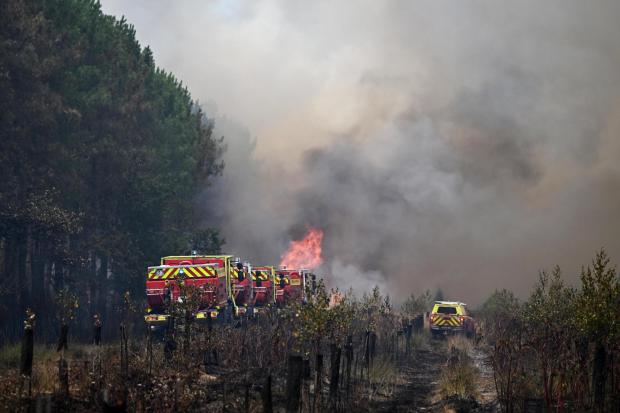
Heat waves and minimal rainfall in Europe have led to unprecedented wildfires in France and Spain. These fires have prompted one of Europe’s largest evacuations since World War II, affecting hundreds of thousands.
Rising Temperatures Intensify Efforts
Increasing temperatures could hinder firefighting efforts. The fires have already consumed an area four times the size of Paris in southwestern France and edge towards Madrid, Spain’s capital. Climate data reveals that Europe is warming faster than any other region. The continent has faced several extreme heat events this year.
In Spain, firefighters have termed the fires as too fierce to confront directly, though a slight relief came in France, where the spread in the Gironde region might have slowed.
Impact of Climate Change
The combination of Europe’s prolonged heatwave and low rainfall created dry conditions. June’s record temperatures in Western Europe drew moisture from vegetation, fueling fires. A study by World Weather Attribution noted that recent heat records were not possible without climate change.
France experienced its hottest June with temperatures averaging 6.8 degrees Fahrenheit above normal, coupled with nearly 50% less rainfall. In Spain, the warmer and drier summers, compounded by reduced farming, turned forests into fire-prone areas.
Record-Breaking Fires This Year
Authorities report record-setting fires in both nations. The EU’s European Forest Fire Information System estimates over 1,160 square miles have burned. France’s Interior Ministry records 13,566 fires across 448 square miles, marking a record high.
Spain reported 591 square miles burned, surpassing prior records. Among these, Ávila in rural Spain witnessed its largest fire, consuming over 193 square miles, a size five times that of Barcelona. A significant fire in Almeria claimed 13 lives.
Mass Evacuations Underway
Over 300,000 people have evacuated in France and Spain. In France, over 250,000 left their homes, primarily in Gironde. This comes as France nears its tourist season, prompting bans on holiday camps in affected areas.
In Spain, 79,000 people relocated from areas like west of Madrid and Castellón, while 30,000 were confined to homes.
International Assistance Mobilized
The EU dispatched seven planes and four helicopters from several countries to aid France, and six planes to Spain. European Commissioner for crisis management, Hadja Lahbib, reassured that no nation faces such disasters alone, pledging support until the fires are controlled. Additionally, the Copernicus satellite program is assisting emergency services with updated fire risk maps.