
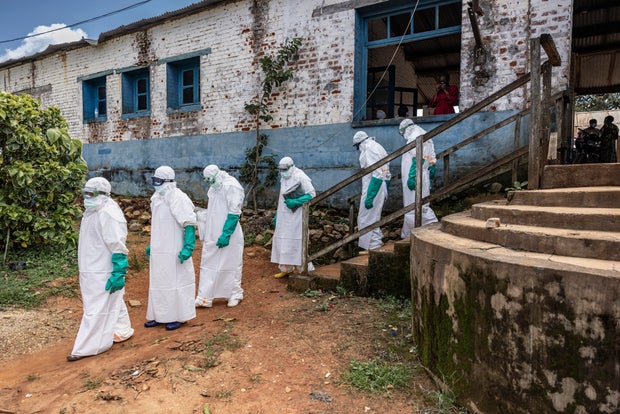
The ongoing Ebola outbreak has claimed the lives of at least 220 people, as reported by Tedros Adhanom Ghebreyesus, Director-General of the World Health Organization (WHO). The delay in identifying cases has posed challenges for health workers, prompting them to “play catch-up.” WHO has declared the outbreak a public health emergency of international concern.
In Uganda, health authorities have reported two additional Ebola cases, raising the total number of infections to seven. These cases are linked to the outbreak in the neighboring Democratic Republic of Congo (DRC), where suspected cases have exceeded 900. The outbreak officially started on May 15, but some cases may have emerged earlier.
A 59-year-old Congolese man was admitted to a hospital in Kampala, Uganda’s capital, on May 11. He passed away three days later, before it was confirmed he had the Ebola virus. Additional Congolese nationals seeking medical care in Uganda later tested positive. Uganda’s Ministry of Health has confirmed local infections, including a driver and a health worker exposed to a Congolese patient.
The outbreak predominantly affects the eastern Ituri province of Congo, where over 100 confirmed cases have been recorded. The response faces hurdles such as fear and distrust among locals, with attacks on treatment centers and skepticism towards authorities.
The Bundibugyo strain of the Ebola virus causing this outbreak lacks an approved vaccine or treatment. Researchers at the University of Oxford are developing a vaccine that might begin clinical trials soon.
“Mongbwalu General Hospital is on general alert,” remarked Dr. Richard Lokudu during a phone call with The Associated Press. He described an assault by angry young men demanding bodies of their relatives, accompanied by gunfire.
This marked the third attack on healthcare facilities within a week. Ebola victims’ bodies can be highly contagious, prompting the government to oversee burials to prevent further spread. This policy has led to protests.
Authorities have banned funeral wakes and gatherings exceeding 50 people to contain the virus, particularly in northeastern Congo. On Saturday, Mongbwalu residents attacked and burned a tent set by Doctors Without Borders for suspected cases. During this incident, 18 people left, currently unaccounted for.
Despite WHO assessing a “very high” risk for Congo, the global spread risk remains low. The International Federation of Red Cross and Red Crescent Societies reported that three volunteers died in Mongbwalu, believed to have contracted Ebola on March 27 while handling bodies in a mission unrelated to Ebola.