
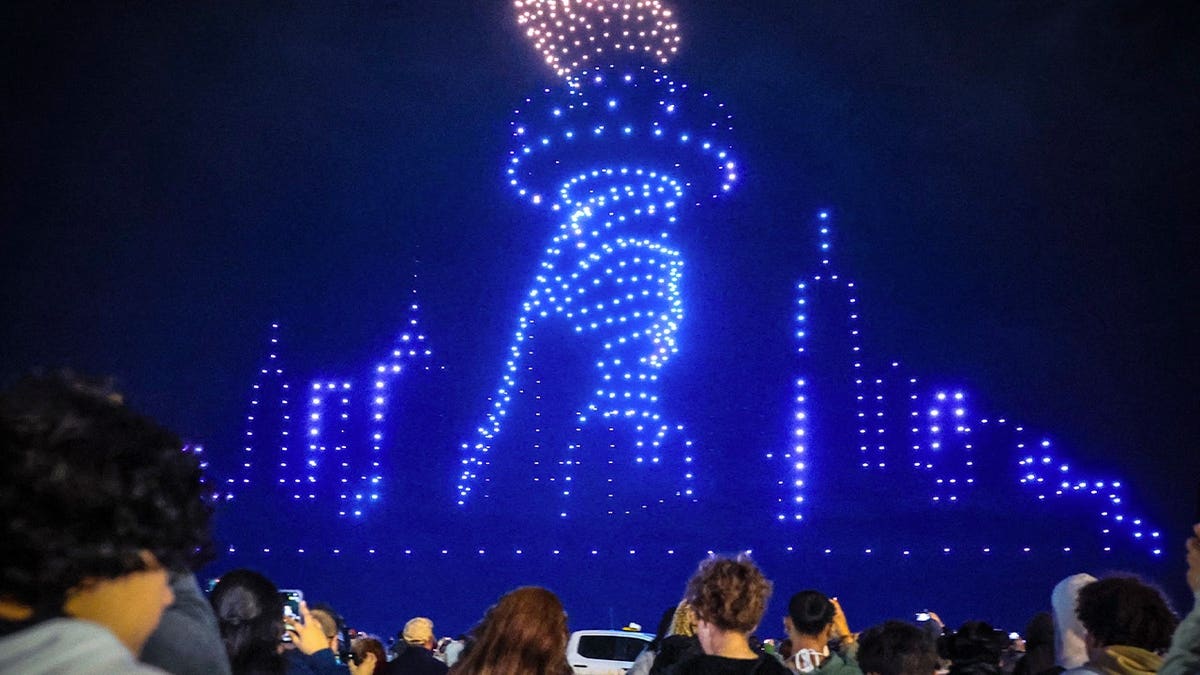
Drone shows are swiftly taking the place of traditional fireworks at concerts, sporting events, and Fourth of July celebrations. Communities view them as a safer and more environmentally friendly option. But as these displays become common, security experts worry about the crowded skies.
Cordell Bennigson, CEO of U.S. Operations at R2 Wireless and a retired Marine Corps officer, explains these shows highlight the accessibility of drone technology. This accessibility presents new challenges for maintaining event security and public safety.
A drone show itself isn’t a security risk, but it’s an indication of how accessible drones are.
Drones operate on the radio frequency (RF) spectrum, which can become crowded during shows. This can complicate efforts by security officials to identify unauthorized drones among legitimate electronic signals. Bennigson emphasizes the importance of developing better detection systems to mitigate these risks.
While reducing wireless transmissions may seem like a solution, Bennigson argues it’s unrealistic. Instead, he believes efforts should focus on improving detection within the noisy RF spectrum.
We have to get better at seeing in the electromagnetic spectrum, which is what our focus is at R2, being able to do exactly that.
Artificial intelligence (AI) plays a crucial role in detecting suspicious activity by sorting through large amounts of wireless data. AI can swiftly identify patterns and new, unfamiliar signals, enhancing detection capabilities.
Bennigson advises that cities, states, and federal regulators need to adapt to the challenges posed by increased drone traffic. The FAA must consider systems beyond radar to monitor airspace effectively, especially to detect drones not following legal protocols.
If the FAA is only relying on radar and only relying on friendly transmitters, that leaves a gap for some bad actors to operate without being seen.