
As August approaches, two major questions about the Dodgers arise. Will they secure a third consecutive World Series win? Will the $500-million gondola project from Union Station to Dodger Stadium succeed or fail?
The first remains unpredictable. However, the gondola plan, led by former Dodgers owner Frank McCourt, faces significant challenges. Environmentally, it would affect L.A. State Historic Park by removing trees and disregarding community planning efforts. Significant opposition includes seven former state park officials and four ex-members of the Park and Recreation Commission.
“Gondola cars encased in digital ads, flying 26 feet overhead every 25-30 seconds, would irreparably impair the vista and the sense of calm and escape from urban life,” wrote former state parks director Ruth Coleman.
Former commissioners have voiced concerns too. They argue that the project represents a threat to the park’s integrity. This controversy arises as the state considers amending the park’s plan to evaluate the gondola proposal, initially conceived by McCourt in 2018.
A fall hearing will likely be contentious. In December, a Metro board meeting polarized supporters and opponents. Though the board approved the gondola, the L.A. City Council opposes it. The upcoming decisions may prove as heated as the World Series itself.
The gondola’s fundamental aim is to transport fans and reduce traffic, benefiting McCourt, who retains financial interests in Dodger Stadium parking. Yet questions persist. Would the gondola replace existing free shuttles from Union Station? The future development of stadium property into a Dodgertown commercial complex remains uncertain.
The claim that private funds will bankroll the gondola, with free rides for ticket holders, invites skepticism. Could public money eventually be diverted to support this? As my colleague Bill Shaikin suggested in 2022, improving access for pedestrians and cyclists offers a better solution than a gondola.
Impact on L.A. State Historic Park
Initially, Chinatown residents resisted the gondola, likening it to an amusement ride looming overhead. Concerns extend beyond this, focusing on impacts within the park.
Sean Woods, ex-state parks employee, pointed out that many trees would disappear if the gondola traverses the park. Formerly involved in community-driven park development, Woods criticized the plan as a betrayal of commitments to local communities.
Surrounded by greenery, the gondola would affect the park minimally, covering a small section of its 32 acres. Still, every visitor would notice its presence.
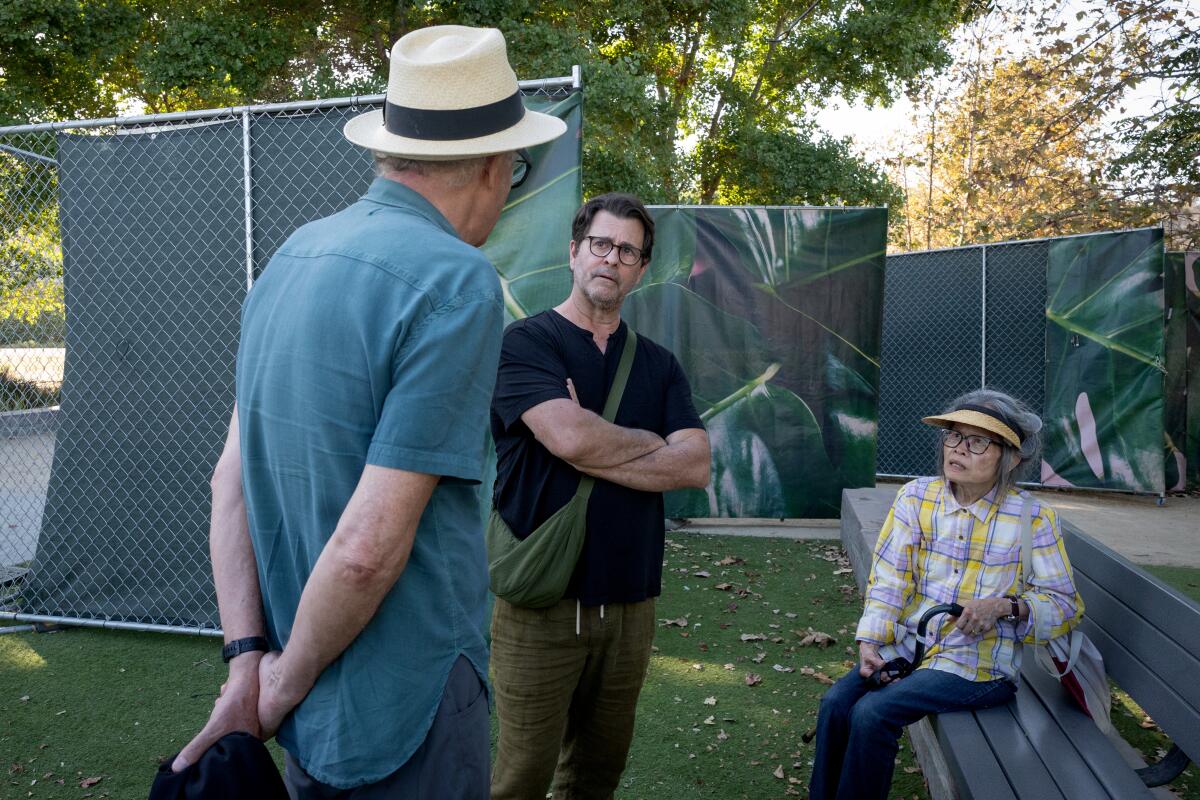
Susan Lai, involved with Friends of Los Angeles State Historic Park, opposes the project. “This is called a historic park for a reason,” she noted, emphasizing McCourt’s lack of historical or cultural connections to the space.
She highlighted political influences potentially overriding local interests. Her dedication honors late husband Collin’s vision for the park. Jon Christensen, another gondola opponent, noted Lai’s impact on younger generations, energizing the movement.
Park’s flat beginning has evolved with time, blending activities like picnicking and Frisbee football with a skyline view at risk of obstruction. Symbolically, seeing gondola patrons soaring over a public haven frequented by families signals status disparities.
Gondola routes may overshadow an evolving urban oasis, raising questions about its necessity and impact on community landscapes.