
Cascadia High-Speed Rail Proposal
A long-term blueprint has been unveiled for a high-speed railway that could eventually link three major metropolitan areas in the Pacific Northwest. The Cascadia High-Speed Rail system aims to connect cities across two U.S. states and Canada, namely Portland, Oregon, Seattle, Washington, and Vancouver, British Columbia.
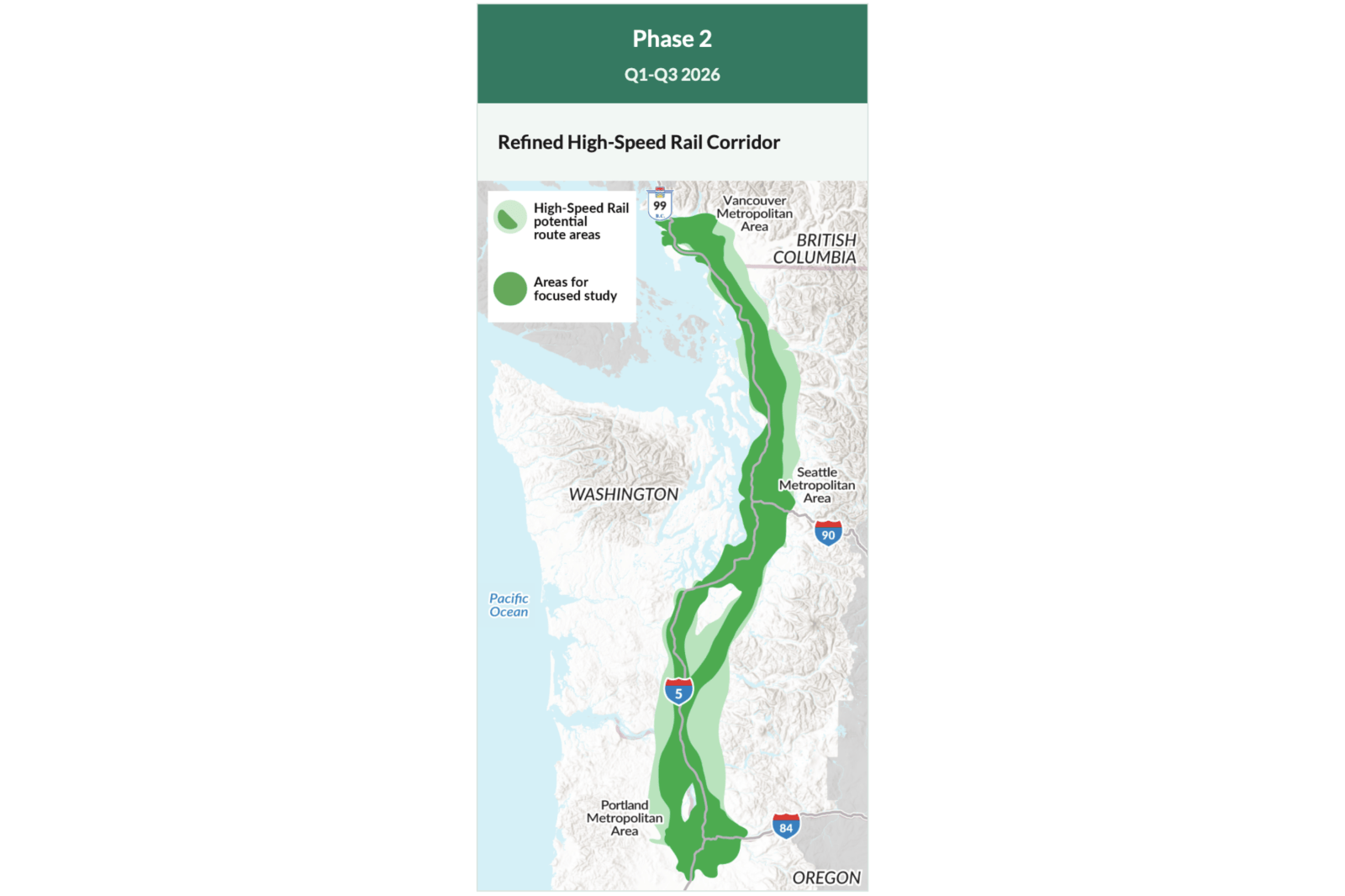
The Washington State Department of Transportation (WSDOT) released a conceptual map showcasing the corridor stretching from Portland’s metropolitan zone, through Washington, up to Vancouver. Although the project is in its nascent stage, the planned route is not finalized, and station locations remain undecided.
WSDOT is inviting public input via an online survey, open until November 13. Feedback from residents, businesses, and regional travelers will help steer the planning of this transportation system.
Understanding the Cascadia Plan
The Cascadia High-Speed Rail concept emphasizes enhanced connectivity among key Pacific Northwest cities. WSDOT collaborates with the Oregon Department of Transportation, Oregon Metro, and British Columbia’s Ministry of Transportation and Transit to develop this cross-border network.
The project is a segment of WSDOT’s broader Cascadia High-Speed Rail and I-5 Program. This initiative explores enhancements to Interstate 5 alongside high-speed rail. It evaluates how various transportation forms, such as roads, railways, airports, and public transit, can operate as a unified regional system.
Funding includes $49.7 million awarded by the Federal Railroad Administration in December 2024 for a Service Development Plan. Additionally, the Washington State Legislature allocated $5.5 million in matching funds. Planning efforts are scheduled to continue through 2028.
Prospective Train Stops
Currently, Portland, Seattle, and Vancouver are identified as the principal metropolitan areas for connection. However, specific stations remain undecided. The Service Development Plan will explore potential routes and service patterns, considering the number of stops and train frequency. Governance and financing strategies will also be assessed.
At this stage, any areas indicated along the conceptual map should not be presumed as definite stations.
Motivation Behind the Proposal
The anticipated growth of the Pacific Northwest serves as a primary impetus for this proposal. WSDOT forecasts an influx of 3.4 million residents by 2050 within the Cascadia megaregion, with expansion across sectors like technology, aerospace, healthcare, and logistics.
Concurrent transportation demands are predicted to rise sharply. Medium to high congestion on Washington’s I-5 may reach 80% by 2050, up from the current 59%. Similarly, Portland’s I-5 congestion is projected at 78% by 2045, a significant increase from 33% in 2019. WSDOT advocates for integrated transport modes to meet future requirements.
California’s Lessons in High-Speed Rail
The Cascadia initiative faces lengthy preparation, paralleling California’s high-speed rail experience. In California, the Central Valley has been under construction for years, yet the broader San Francisco to Los Angeles/Anaheim vision remains incomplete.
The California High-Speed Rail Authority’s 2026 strategy aims to finalize the Merced-to-Bakersfield segment before extending to larger cities. As of July 31, 2026, the authority reported $8.10 billion in expenditures on Central Valley construction, completing 66 structures and 90 miles of guideway.
California has revised plans to control costs, streamlining station designs and infrastructure while planning initial operations. In contrast, Cascadia’s progress is still nascent. WSDOT’s current focus lies in assessing feasibility and economic viability while considering public insights for regional transportation.