
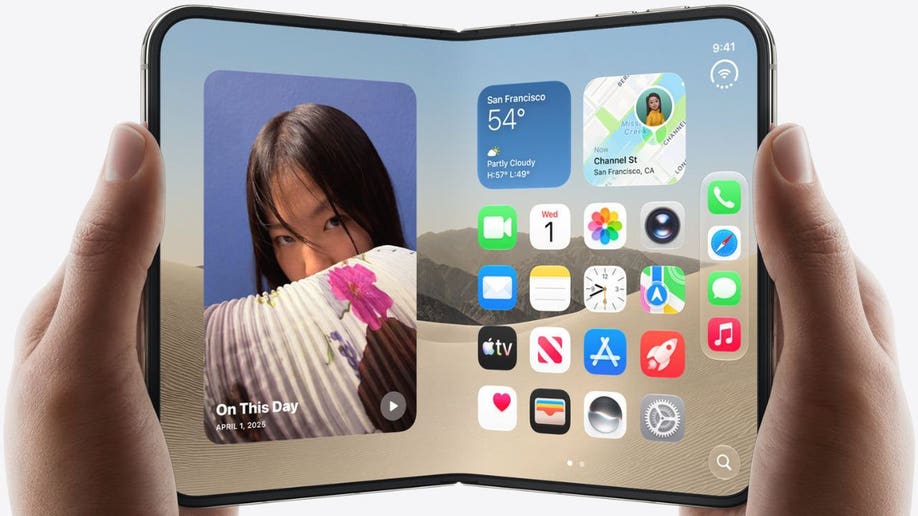
Apple recently introduced its foldable iPhone Duo, priced at $1,999, generating significant attention from consumers. This new device features a dual-screen capability and an ultra-thin design, offering a novel smartphone experience. During the announcement on ‘Varney & Co.’, Taylor Riggs highlighted the unique features of the iPhone Duo. Host Stuart Varney expressed his excitement over the prospect of purchasing the high-end model, which reaches up to $3,000 for the two-terabyte storage version.
The announcement marked Apple’s entry into the foldable phone market, a move long-awaited by consumers after observing the trajectory of competitors like Samsung and Google. However, the event unveiled more than just the Duo. Apple showcased an advanced camera capable of authenticating photos, a more personalized Siri AI, and a new Apple Watch feature to summarize noteworthy conversations. Even the AirPods received significant updates at a reduced starting price.
Some of these advancements seem promising, but they also raise questions regarding privacy, pricing, and the extent of intelligence embedded into our gadgets. Here are eight significant insights gleaned from Apple’s 2026 event and their potential implications for users:
- iPhone Duo: Apple’s monumental leap
The iPhone Duo introduces a 7.6-inch Super Retina XDR display, providing 50% more screen area compared to the iPhone 18 Pro Max. The 5.4-inch outer display offers 90% of the screen area that the iPhone 18 Pro delivers. A custom nano-texture finish reduces glare and reflections and minimizes crease visibility, offering a matte feel to the display.
Noteworthy changes include a switch from Face ID to Touch ID integrated into the side button, accommodating multiple finger enrollments for versatile unlocking. The device supports the Apple Pencil with USB-C later this year and is constructed with Grade 5 titanium, featuring an IP68 rating for dust and water resistance.
The foldable design also allows unique camera functionalities. Dual Capture presents simultaneous front and rear camera feeds during FaceTime. Duo FaceTime uses the outer display for someone next to you to join the call. The outer screen enhances selfie quality via the rear cameras.
Clever features like Duo Preview and Kid Cue make photography engaging through the ability to see the shot in advance and animations to grab children’s attention. Smart Take snaps photos when people are optimally positioned. The Duo’s pricing starts at $1,999 with 256GB of storage, with preorders beginning October 16 and availability starting October 23.
- Revamped iOS for foldable hardware
The redesign of iOS 27 accommodates the foldable Duo, allowing content to move between the outside and inside displays. Apps can expand and occupy the larger screen when opened. Split-screen capability lets you view two apps side by side, enhancing functionality for Mail, Home Screen, Zoom video calls, and Netflix viewing.
Camera features utilize the second screen. Duo Preview helps the person being photographed see the shot through the outer display. Smart Take automatically captures the photo when everyone seems ready. Apple’s emphasis on maximized utility with the foldable design is evident through such integrated features.
- Enhanced photography in iPhone 18 Pro models
While the foldable phone may not appeal universally, Apple has significantly upgraded the camera in the iPhone 18 Pro and iPhone 18 Pro Max. A 48MP Fusion Main camera introduces a variable aperture, automatically adjusting based on lighting and field depth. Four manual aperture settings cater to diverse photographic needs.
The Apple Reference Image feature assures photo authenticity by signing pixel-level data at capture. This function promises value for professional documentation by ensuring image integrity amidst a rise in AI-generated imagery. iPhone 18 Pro begins at $1,199, while iPhone 18 Pro Max starts at $1,299, available for preorder starting September 12 and release on September 18.
- Battery life: The practical yet subtle update
Apple prioritizes prolonged battery life with the iPhone 18 Pro Max. It boasts up to 45 hours of video playback, the longest battery duration to date, and up to 30 hours of general use per charge. Fast charging allows a 50% charge in about 15 minutes using a compatible adapter.
The A20 Pro chip, developed with 2-nanometer technology, enhances compute power with 32 Neural Engine cores. Improved vapor chamber designs optimize heat management, ensuring performance longevity. These enhancements focus on everyday usability through prolonged battery life and optimized processing power.
- Siri AI integration: From promise to practice
Siri AI played a pivotal role during the event, showcasing personalized assistance through contextual understanding across apps. By searching through Mail and Messages, Siri could answer queries, such as planning meals for an upcoming visit. Siri also used the Camera app for object recognition and contextual actions.
A new Siri app allows engagement and conversation continuity on the Home Screen. Conversations can sync privately via iCloud. Launching in beta in English on September 14 with iOS 27, Siri will support other languages later in October.
- Siri Recap and privacy discourse
Apple announced Siri Recap for Apple Watch Series 12 and Apple Watch Ultra 4, offering ambient listening to transform conversations into succinct notes. The notes include titles, summaries, and key points visible in the Siri app. Users manage when Siri Recap is operational to ensure privacy.
Live Rewind allows transcription of the prior 15 seconds, useful in noisy environments. Despite ambient listening concerns, Apple assures no audio recordings are stored. Audio Intelligence processes but shields raw audio from access, including Apple developers. The feature uses end-to-end encryption for synchronization.
Siri AI, Siri Recap, and Live Rewind are slated for beta release later this year in English, facilitating controlled privacy options when active.
- Apple Watch’s commitment to health insights
Apple Watch Series 12 and Ultra 4 enhance health tracking through the Health Sensing System. The Series 12 records heart rates every five seconds and heart rate variability more frequently, delivering tests confirmed to be the most precise in wearables.
The Readiness feature evaluates activity, sleep, and vital signs, offering daily scores to guide exertion and recovery decisions. Apple Watch Ultra 4 achieves up to 50 hours of typical usage, with Max Extended Workout mode lasting 45 hours. Series 12 and Ultra 4 are available for preorder and release on September 18.
The iPhone and Apple Watch collaborate to analyze body movement through Movement Evaluations in the updated Health app, enabling accurate tracking of flexibility, strength, balance, and recovery progress without recording or sharing video footage.
- Value proposition in AirPods 5
Apple’s AirPods 5, priced at $129, introduce Active Noise Cancellation, enhancing audio experience without silicone ear tips. The standard model provides up to four hours of ANC listening, extending to 20 hours with the case. A $149 version includes a volume swipe feature and wireless charging, yielding up to five hours per charge with ANC.
AirPods support Live Translation and Siri AI, showcased by translating conversations on-the-go. Available starting September 18, these earbuds are positioned as accessible alternatives in comparison to expensive foldable phones.
Ultimately, Apple has introduced devices focused on elevating intelligence and practicality, from foldables to everyday wearables. Each development aims to improve consumer experiences and foster consideration between innovation adoption and practicality in maintaining current technology.