
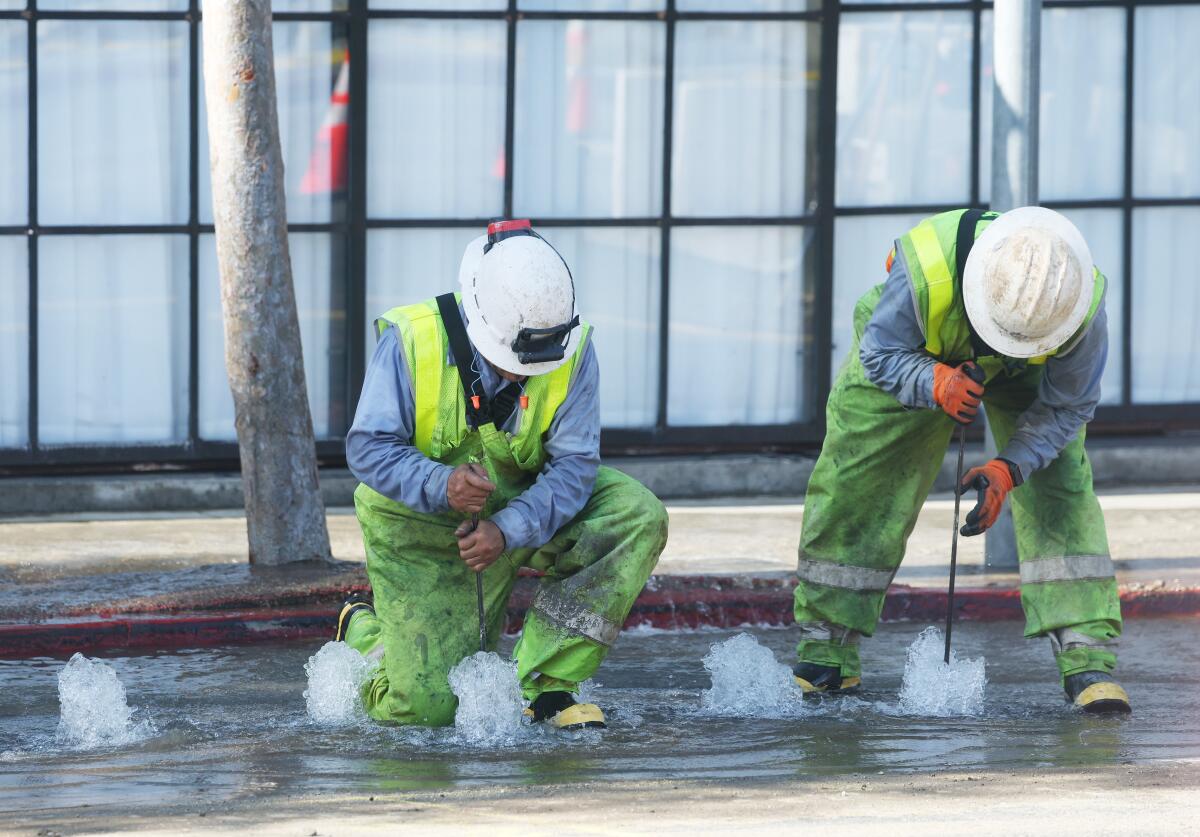
Throughout Los Angeles, an aging underground network of pipes supplies more than 400 million gallons of water daily. We often overlook this system until a major break occurs, as it did on July 17 when a 36-inch water main ruptured under Sunset Boulevard in West Hollywood. This incident resulted in a sinkhole and unleashed 17 million gallons of water onto the streets. Although repairs were nearly finished, another leak surfaced on July 23 nearby at Santa Monica Boulevard and Laurel Avenue.
According to the Los Angeles Department of Water and Power (LADWP), the troubled pipe had been in service for 110 years. This illustrates that even though Los Angeles seems like a relatively young city, it relies on an extensive, aging infrastructure essential to its residents. These pipes have withstood time, from the era of horse-drawn wagons to today’s driverless cars, providing water throughout the city’s growth from a population of about 500,000 to nearly 4 million.
As water travels through these old lines, the risk of damage increases. For Tadeh Ghazalian, owner of Dialog, the July 17 break spelled disaster as it damaged his restaurant, similar to the risks brought about by the failure of other outdated pipes in Los Angeles. The city’s water system includes 6,800 miles of pipes ranging from 4 to 20 inches in diameter, along with an additional 570 miles of broader trunk lines.
Currently, 30% of LADWP’s mainlines are over 80 years old. By contrast, only 3.7% of L.A. County’s population is 80 or older. On previous occasions, such as in 2014, older pipes have also failed dramatically. Yet, like humans, older pipes can sometimes outperform younger ones.
Age is not the only factor influencing a pipe’s condition,said Anselmo Collins, head of water systems at LADWP.
USC engineering professor Lucio Soibelman confirmed that a 100-year-old pipe could remain in perfect condition, contingent on various factors like soil compaction and water table changes. The question arises of whether LADWP leadership inadequately maintained its foundational infrastructure. Despite historical billing scandals and other issues, LADWP currently replaces approximately 45 miles of water lines annually, aiming for pipes with a lifespan of 150 years.
Loyola Marymount University professor Joseph Reichenberger suggested that replacement efforts should have begun decades earlier. However, Soibelman noted that cities like Philadelphia and Boston experience more frequent breakdowns, while LADWP uses advanced monitoring to minimize leakage.
Comparatively, other regions have older but still functioning systems. For instance, in Cambridge, historical water infrastructure replacements follow a plan to replace 150 miles of pipes over five years. Soibelman highlighted European cities’ improved infrastructure due to their emphasis on walkability, unlike car-centric Los Angeles.
Maintaining and upgrading infrastructure in Los Angeles faces challenges due to financial constraints, infrastructure disruption, and traffic impacts. According to Collins, increased replacement efforts would necessitate larger investments from taxpayers.
Reflecting on Los Angeles’ growth, it’s clear that infrastructure ages, much like the people and businesses established alongside it in 1916. Some senior citizens, like the Rocky and Bullwinkle statue at Sunset and Holloway, remain resilient despite their age.