
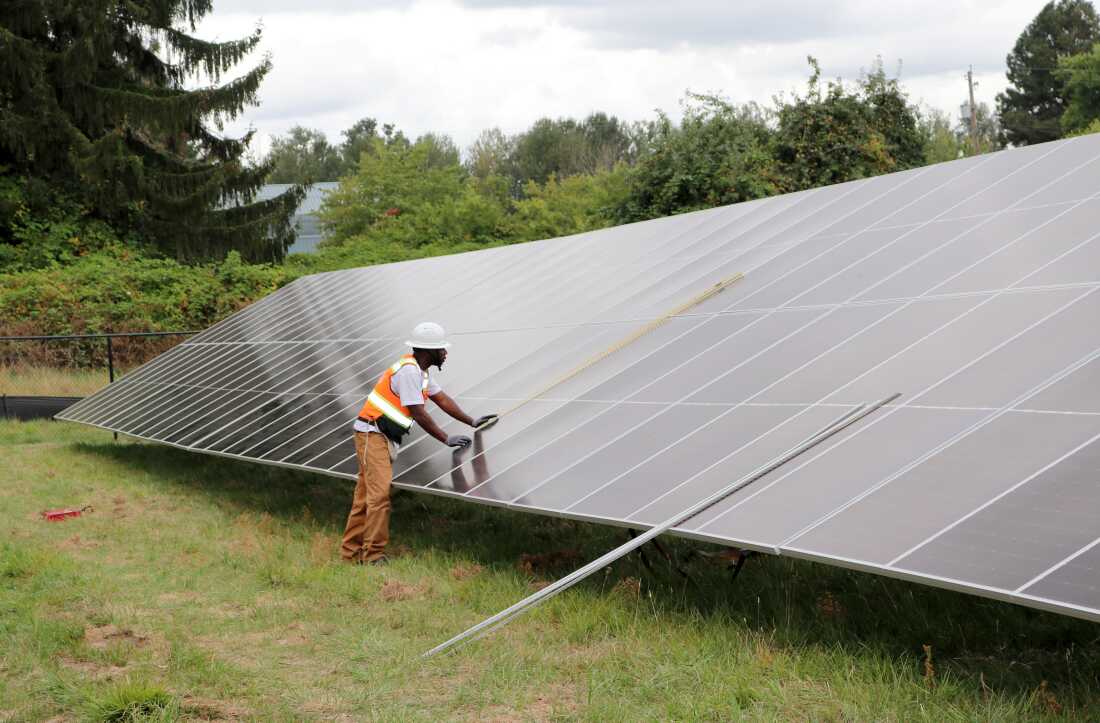
The PDX Community Solar project is powered by a grant exceeding $4 million from the Portland Clean Energy Fund. This initiative provides electricity to eligible low-income residents in the Cully neighborhood of Portland, Oregon.
NPR highlights stories and conversations on community-driven climate solutions. As the federal government pulls back on climate change plans, local entities aim to bridge the gap. This includes reducing emissions and adapting to severe weather conditions.
Portland’s Local Climate Efforts
Over the past seven years, Portland has advanced environmental projects benefiting 150 low-income families by lowering their energy bills. The city distributed more than 20,000 free air conditioning units to prepare at-risk households for heat waves. Additionally, energy efficiency updates have been made in 3,100 homes. Training programs have equipped 2,000 individuals in the renewable energy and construction fields. These initiatives have been possible through an innovative billion-dollar climate fund.
The Birth of the Portland Clean Energy Fund
The Portland Clean Energy Fund, a pioneering initiative, stands as a racial, social, and climate justice fund. Aimed at assisting the city’s most vulnerable residents, it not only helps them adapt to climate change but also contributes to emission reductions. Enacted by a 65% voter majority in 2018, the city initiated a 1% retail sales tax on large corporations like Target and Walmart in 2019. This tax, levied on companies’ sales, has raised approximately $1 billion, with projections to reach $1.6 billion by mid-2029.
According to Sam Baraso, the program manager, the fund is designed to scale up local climate solutions that address pressing climate concerns, community resilience, and economic stability.
Results Achieved
Among the ongoing projects are:
- Distribution of over 20,000 portable air conditioning units since 2022.
- Community solar project supporting 150 low-income families in a predominantly Latino neighborhood.
- Planting of 15,000 trees over five years in urban heat-prone areas.
- Transformation of six parking lots into urban gardens and community spaces, equivalent to eight NBA basketball courts.
Since 2021, the fund has awarded grants totaling about $262 million. These funds span over four rounds, with amounts ranging from $8,000 to $10.3 million, aiding in emission reductions. Completed projects from the first three rounds have reduced approximately 25,500 metric tons of carbon emissions, paralleling the effect of taking around 6,000 vehicles off the road for a year. As more projects commence, these numbers are expected to rise.
Financial Debates and Expansion
The fund’s unexpected financial growth has sparked discussions among officials and local business groups. Portland Mayor Keith Wilson proposed allocating $75 million from the fund to revamp the Moda Center with eco-friendly technology. Some argue this doesn’t align with the fund’s purpose of aiding vulnerable communities.
The Portland Police Association suggested diverting 25% of the fund’s annual revenue to hire 400 more police officers, based on claims of insufficient law enforcement. Critics believe it’s crucial to preserve the fund’s original mission. This proposal may be put to a vote soon.
Influence Beyond Portland
The success of the Portland Clean Energy Fund has caught the attention of other cities. Ann Arbor, Michigan, Denver, Colorado, and Seattle, Washington, have established similar funds. Elizabeth Babcock, head of Denver’s Office of Climate Action, noted inspiration drawn from Portland’s model but highlighted local constraints leading to their decision to adopt a 0.25% sales tax instead. This tax, exempting essentials like food and medicine, generated $41 million in its first year.
Ann Arbor took a different approach by raising property taxes for climate initiatives. An increase in similar local funds is seen nationwide, according to Amruta Nori-Sarma, an assistant professor at Harvard. She emphasizes that community involvement is critical in tailoring solutions to local needs, especially in smaller towns lacking large retailers.
The Portland Clean Energy Fund commits to investing $1.6 billion back into the city, set to conclude its initial five-year plan by mid-2029.