
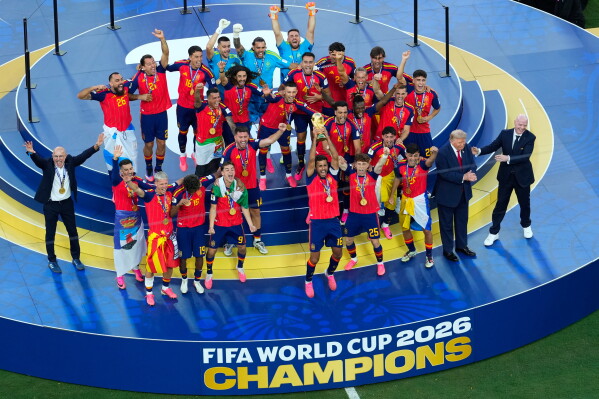
The World Cup winner will lift a trophy, receive championship rings for the first time, and earn a place in sports history. It also brings a financial reward. The winning team will receive $51 million, and the runner-up will earn $34 million.
For the 2026 World Cup, FIFA increased the total payout, reaching a record $871 million for the 48 participating teams. This includes over $100 million added in April, following lobbying by European federations to help cover extensive travel and lodging costs across three countries.
While $51 million for the winner, either Argentina or Spain, is significant, it is less than what some global soccer expenditures amount to. For example, it is smaller than what Brighton paid for 19-year-old defender Luka Vušković, who was mostly a bench player during the World Cup.
How Prize Money is Distributed
All 48 teams receive funds from FIFA in two main categories: prize money bonuses and across-the-board payments for training and preparation costs. Each team gets at least $12.5 million, including $10 million for participating in the group stage and $2.5 million for pre-tournament expenses. This upfront money aims to prevent disputes about unpaid bonuses, which were common in the past.
The prize amount increases based on how far teams progress in the tournament:
- Runner-up: $34 million
- Third place: $30 million (for example, England)
- Fourth place: $28 million (for example, France)
- Quarterfinalists: $20 million each
- Round of 16: $16 million each
- Round of 32: $12 million each
- Group stage participants: $10 million each
Pressures for Higher Payments
Some federations, particularly in Europe, pressured FIFA to change the prize money structure. They argued that the previous payout would result in financial losses unless teams advanced deep into knockout rounds. This point was emphasized by France’s federation president, Philippe Diallo, highlighting the disparity compared to what Chelsea received as the Club World Cup winner, $115 million. Teams also faced tax obligations in the U.S., not applicable in Canada and Mexico.
Additional Support for Teams
FIFA covers additional expenses under its regulations. These include business-class return flights for each federation and board and lodging for a 50-person delegation, covering players and staff. The accommodation begins five nights before the first game and lasts until a day after elimination. Domestic travel for up to 50 delegates and a fleet of vehicles, including an equipment truck, are also provided.
Teams must handle insurance, incidental hotel costs, and housing extra delegation members.
The Coveted Trophy
Beyond the financial rewards, the ultimate honor is the World Cup trophy. After the final match, the champions will celebrate with a replica of the original trophy, which is not awarded permanently.
FIFA allocates prize money to federations, not directly to players. Federations decide how to distribute it. For instance, U.S. Soccer will retain 20% of the prize money, with the remaining 80% evenly divided between the men’s and women’s national teams, following an agreement for equal pay reached in 2022.