
Recent revelations about a British naval drone unknowingly transmitting data to China highlight a critical warning for U.S. policymakers.
During a cybersecurity assessment, the U.K. Ministry of Defence identified a significant security breach. They discovered that a component in their naval drones was secretly sending data to China, despite the drone being British. This incident exposes a vulnerability exploited by China’s strategic plans.
CHINESE DRONE MONOPOLY PUT ON NOTICE AMID CONCERNS OVER CCP SPYING: ‘STRATEGIC MISTAKE’
China employs methods such as intellectual-property theft, cyberespionage, and targeted industrial policies. These strategies make it essential to Western supply chains. China then leverages this position to collect intelligence and create vulnerabilities against its adversaries.
The typical response from the U.S. has involved restricting Chinese technology after risks become undeniable. This has often required spending billions to replace equipment already integrated into American systems.
CHINESE ESPIONAGE STEALS $600 BILLION FROM US FIRMS YEARLY. IT’S TIME FOR GOVERNMENT TO ACT
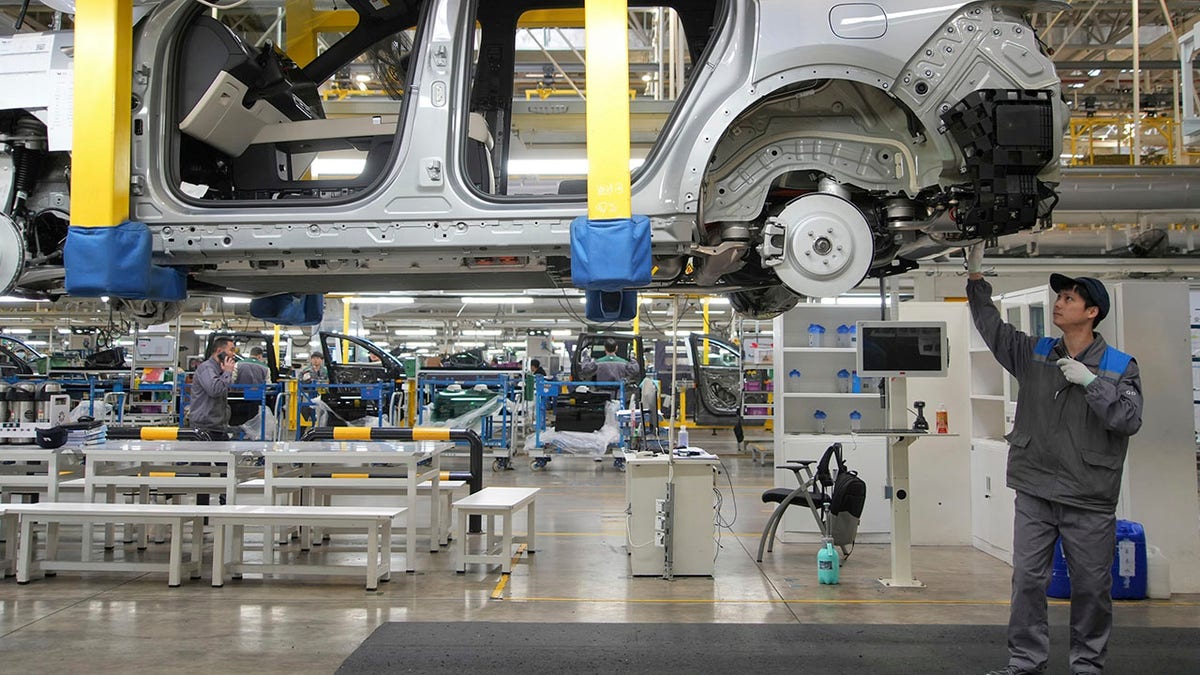
An accompanying image shows a worker assembling an SUV at a car plant of Li Auto, a significant Chinese electric vehicle (EV) manufacturer, in Changzhou, Jiangsu province, on March 27, 2024.
China now targets automobiles for espionage and sabotage, but the U.S. can address this issue before it escalates. China, the leading vehicle exporter, significantly influences the global automotive sector. Chinese companies advance in EVs, batteries, software, and critical car technologies.
With cars becoming increasingly connected, China’s entry into the U.S. market presents severe security risks. Modern vehicles are equipped with cameras, microphones, sensors, and internet-connected hardware, gathering vast amounts of data. This information includes steering, braking, and acceleration functions controlled by software.
KARR BLUETOOTH FLAW EXPOSES 2.2M CARS TO THEFT RISK
Control in the wrong hands transforms these technologies into tools for espionage or allowing adversaries to manipulate or disable vehicles remotely.
While Chinese cars on American roads highlight direct threats, Chinese companies could infiltrate the U.S. automotive landscape without directly selling vehicles. Chinese components in vehicles from American, European, Japanese, or South Korean brands pose similar risks.
At a broad scale, embedded technologies would offer China detailed intelligence on American homeowners, workplaces, travel routes, and locations of sensitive facilities.
FOREIGN ROBOT BAN TARGETS CHINA OVER SECURITY FEARS
In conflicts, these vulnerabilities could extend beyond surveillance. A single adversary could exploit flaws in millions of vehicles to disrupt nationwide transportation.
China’s strategies in entering U.S. markets as an automotive power put American manufacturers at risk. As cars get more connected, they pose severe security threats.
Congress has a chance to counteract these threats before they become widespread by passing the bipartisan Connected Vehicle Security Act. Sponsored by Ohio Republican Sen. Bernie Moreno and Michigan Democrat Sen. Elissa Slotkin, this legislation reinforces the Commerce Department’s connected-vehicle rule.
CHINA-LINKED HACKERS INFILTRATED US GOVERNMENT NETWORKS BEFORE FBI TAKEDOWN
The legislation aims to restrict vehicles, software, and connectivity hardware associated with foreign adversaries. The Commerce Department concluded that allowing such access risks sensitive data collection and vehicle remote manipulation.
While executive rules can be overturned, Congress can enact enduring measures. Only congressional action can provide lasting national security protections.
CHINESE HACKERS TARGET NASA AND KEY US AGENCIES, DOJ ALLEGES
The Connected Vehicle Security Act would solidify the protections set by the Commerce Department’s rule-making within the supply chain. This act concentrates on the integrated technologies in vehicles, such as software, communication tools, and electronics in batteries.
The Senate Commerce Committee unanimously advanced the bill in July. Congress should approve this legislation and forward it to the president.
The U.S. often faces challenges in untangling its reliance on Chinese technology. The proliferation of connected vehicles represents a chance to act before traditional dependencies entrench further.
Chad F. Wolf served as acting Secretary of the U.S. Department of Homeland Security during President Trump’s first term.