
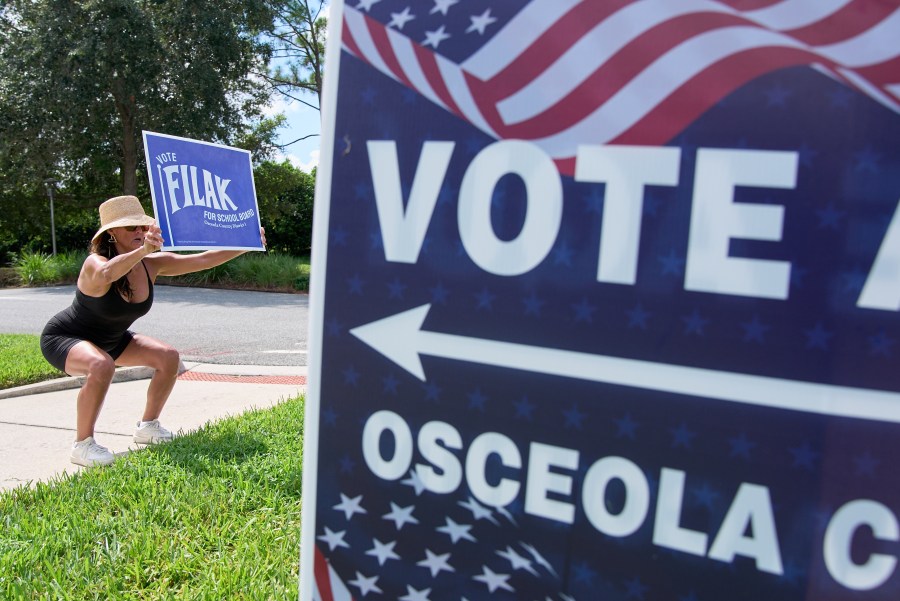
Regardless of the campaign signs in your yard or how much you support a candidate, expressing that support openly can affect your ability to vote for them. More than half of U.S. states restrict wearing campaign apparel while voting, and nearly all prohibit signs, banners, or literature near polling places according to the National Conference of State Legislatures.
Elections and Dress Codes
In 2024, controversies around these restrictions arose when JD Vance commented on a photo of a woman reportedly voting shirtless after being told her Trump campaign shirt violated rules. She removed the shirt after expressing her frustration to the poll worker. Electioneering rules aim to prevent voters from feeling pressured or intimidated, explained Quinn Yeargain, an associate professor of law at Michigan State University. The rules preserve polling places as neutral areas.
Twenty-seven states have rules against campaign wearables like stickers, shirts, and buttons, according to the NCSL. Vermont voters must cover up “candidate paraphernalia” at polling places. Similar rules exist in Michigan, Minnesota, and Texas.
Vermont officials stated, “The polling place is about voting, not campaigning – once voters have entered the polling place, the campaigns have ended.” In Colorado, Louisiana, and Nebraska, voters can’t wear items related to any candidate or measure on this year’s ballot.
In Delaware, Georgia, and Oklahoma, voters cannot wear items supporting candidates at polling places. Other states such as Arkansas, California, Hawaii, Indiana, Kansas, Massachusetts, Montana, Nevada, New Jersey, New Mexico, New York, North Dakota, Ohio, Rhode Island, South Carolina, and Tennessee enforce similar restrictions, according to NCSL.
Though Maryland and Iowa permit campaign-related attire or buttons, voters must leave the premises immediately after voting. New Hampshire makes exceptions for voters who cannot reasonably remove or cover items with electioneering messages, allowing such voters to “expeditiously [register] to vote or [vote].” In Alabama, voters are advised against loitering or leaving campaign material at polling places. Pennsylvania prohibits campaigning or promoting candidates inside the polling site.
In Virginia, voters, but not election workers, may wear campaign items.
Rules on Campaigning Near Polling Places
Nearly all states have regulations against campaigning within a defined distance from polling locations. In Massachusetts, political activities aimed at influencing the current election are banned within 150 feet of the polling place. Similarly, Georgia enforces a 150-foot restriction.
Nebraska requires campaigning to begin at least 200 feet away, Idaho law sets the boundary at 250 feet, while in Oklahoma, the boundary is 300 feet. Restrictions start within 500 feet in South Carolina and 600 feet in Louisiana.
In Pennsylvania, campaigning is restricted to at least 10 feet from the entrance to the voting room. Alabama’s law specifies no electioneering within 30 feet of the entrance. Maryland polling places establish lines “as near as practicable to 100 feet” from entrances. Colorado prohibits campaigning within a 100-foot radius of polling locations and ballot drop-boxes.
Similar restrictions exist in Minnesota, Texas, and West Virginia. New Hampshire law mandates “no-electioneering corridors” at least 10 feet wide stretching from polling place entrances to adjacent sidewalks or parking lots.
Before voting, verify the local rules on campaigning at or near your polling place.