
U.S. Vice President JD Vance arrived in Switzerland on Sunday to initiate formal discussions with Iranian officials. These talks aim to curb Iran’s nuclear program and expand the delicate interim deal to terminate the conflict in Iran.
Vance, accompanied by his spouse Usha Vance, touched down at Emmen Air Base near Lucerne just before 6 a.m. local time. This visit follows the framework signed last week, with the U.S. and Iran negotiators embarking on a 60-day push to finalize technical details significant to the global economy and security.
However, the outset of this two-month period has been complicated by fiery exchanges in Lebanon between Israeli forces and Hezbollah, an Iranian-backed militant group. Iran’s military announced the closure of the Strait of Hormuz, a crucial passage for a fifth of the world’s traded oil and natural gas, adding further tension.
Vance’s initial plans to be at Bürgenstock resort near Lucerne on Friday were hindered by escalations in Lebanon. Consequently, Iranian officials withdrew from the talks. The U.S. Central Command countered Iran’s claims about shutting the strait, affirming that traffic continues and billions of oil barrels have moved through in recent days.
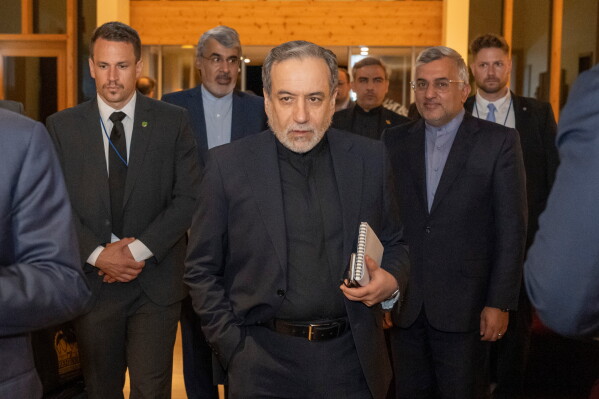
Iranian negotiators, including parliamentary speaker Mohammad Bagher Qalibaf and Foreign Minister Abbas Araghchi, joined the discussions, alongside U.S. special envoy Steve Witkoff and Jared Kushner. Pakistani Prime Minister Shehbaz Sharif and army chief Field Marshal Asim Munir, along with Qatari mediators, are participating in the talks.
Although Vance intends to remain in Switzerland for merely a couple of days, his presence has intensified scrutiny of the vice president, especially as he contemplates a 2028 presidential campaign.
The agreement between the U.S. and Iran, endorsed by President Donald Trump and Iranian President Masoud Pezeshkian, permits Tehran to sell its oil freely and access billions in previously frozen assets. It requires Iran to dilute its stockpile of highly enriched uranium, which was targeted in U.S. strikes last summer.
The deal allows commercial vessels to transit the Strait of Hormuz for 60 days toll-free, but does not prevent Iran from imposing future charges. Trump warned of potential U.S. tolls on the strait if no deal materializes within 60 days, indicating such measures would finance “services rendered as the Guardian Angel to the Middle East.”
Adding to the complexity, neither Israel nor Hezbollah are parties to the U.S.-Iran agreement. Israeli Prime Minister Benjamin Netanyahu pledged to continue Israeli military presence in southern Lebanon until threats to Israel are neutralized. Hezbollah demands Israel’s withdrawal from Lebanon as a condition to cease hostilities.
Recent clashes between Israel and Hezbollah claimed 47 lives in Lebanon and caused deaths of four Israeli soldiers.
Reporter Kim provided insights from Washington.