
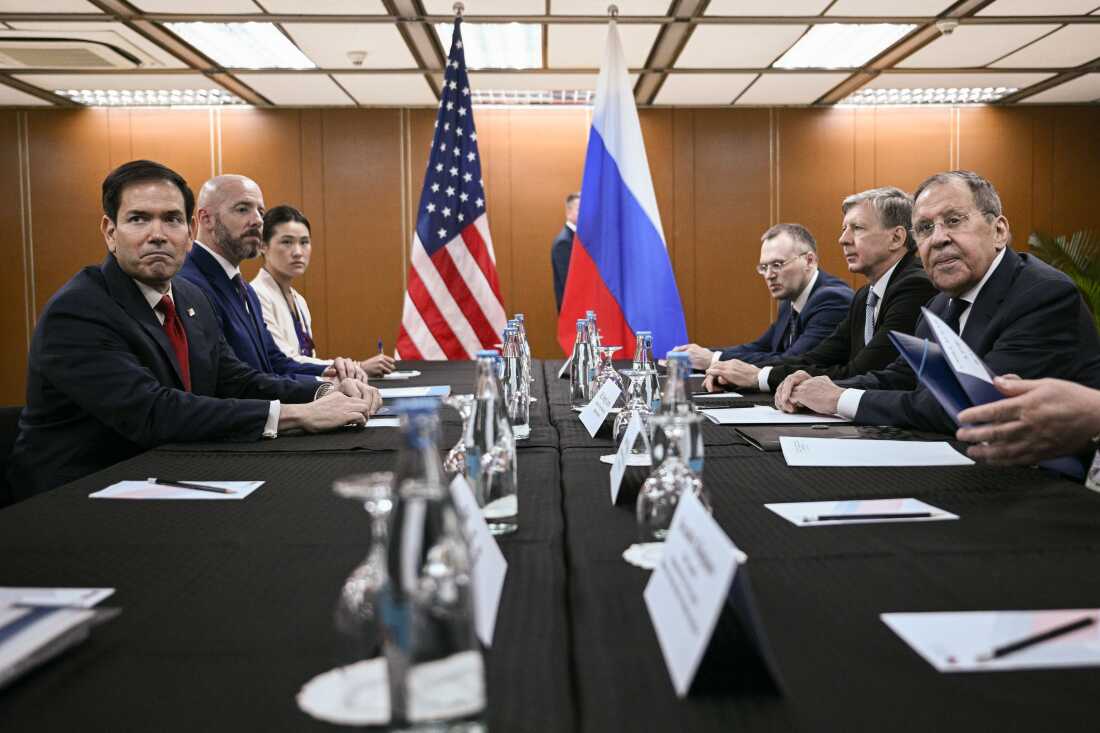
In Pasay, Metro Manila on Thursday, July 23, 2026, U.S. Secretary of State Marco Rubio attended a meeting with Russia’s Foreign Minister Sergey Lavrov during the Association of Southeast Asian Nations (ASEAN) Foreign Ministers Meeting. Rubio emphasized the Trump administration’s readiness to help end the war in Ukraine, acknowledging that achieving a quick diplomatic resolution remains challenging.
Rubio commented on past U.S.-mediated talks with Russia, labeling them as unproductive, while stressing President Donald Trump’s commitment to facilitating a resolution if conditions change. He stated the necessity for finding an acceptable end for both parties, expressing U.S. preparedness to partake in diplomatic efforts if opportunities arise.
During the ASEAN meeting, Rubio also interacted with several other leaders, including China’s foreign minister. The discussions mainly revolved around international conflicts, focusing on escalating tensions in the Middle East and the South China Sea. Rubio reassured that while the U.S. combats challenges in Iran, seeks solutions for Russia’s war in Ukraine, and confronts issues involving Cuba, America’s engagement in Asia remains constant through solid partnerships and economic ties.
After Rubio’s meeting, Lavrov refrained from addressing reporters, but the Russian Foreign Ministry later accused European countries of inciting strategic defeat for Russia and opposed further arming of Ukraine. Lavrov reiterated Russia’s readiness for diplomatic resolutions, referencing agreements from a prior summit between Putin and Trump in Alaska.
Continuing military support for Ukraine was confirmed by Rubio, as NATO allies purchase and transfer weapons to the nation. Meanwhile, Ukrainian President Volodymyr Zelenskyy stressed negotiation prioritization. Rubio noted that U.S. diplomatic efforts face challenges from Iran-related tensions following a ceasefire collapse and intensifying strikes between Washington and Tehran. Rubio articulated Trump’s stance on Iran’s aggression, warning of significant consequences for ongoing hostilities.
In relation to China, Rubio and Australian Foreign Minister Penny Wong criticized China’s recent missile test from a nuclear-powered submarine. Wong highlighted destabilization concerns due to a lack of notice to affected nations, accentuating China’s military build-up and asserting provocations. China’s defense of the missile launch as routine exercises was cited, with a claim of advance notice to relevant countries.
Rubio’s discussions with China’s Foreign Minister Wang Yi touched on an altercation between Chinese and Filipino forces in the South China Sea. Rubio cautioned potential conflict impacts between the U.S. and China. He also anticipated Chinese leader Xi Jinping’s upcoming Washington visit optimistically.
The Chinese coast guard’s defense against Philippine accusations cited operations as professional, while the Philippine coast guard condemned China’s actions as coercive. The dispute involved harassment claims against Filipino vessels aiding fishermen in the Scarborough Shoal.
The Trump administration has continuously criticized China’s assertive actions in the South China Sea, as tensions persist involving ASEAN members like Vietnam, Malaysia, Brunei, and Taiwan. ASEAN aims to finalize negotiations with China on a non-aggression pact to prevent conflicts in the crucial trade route.